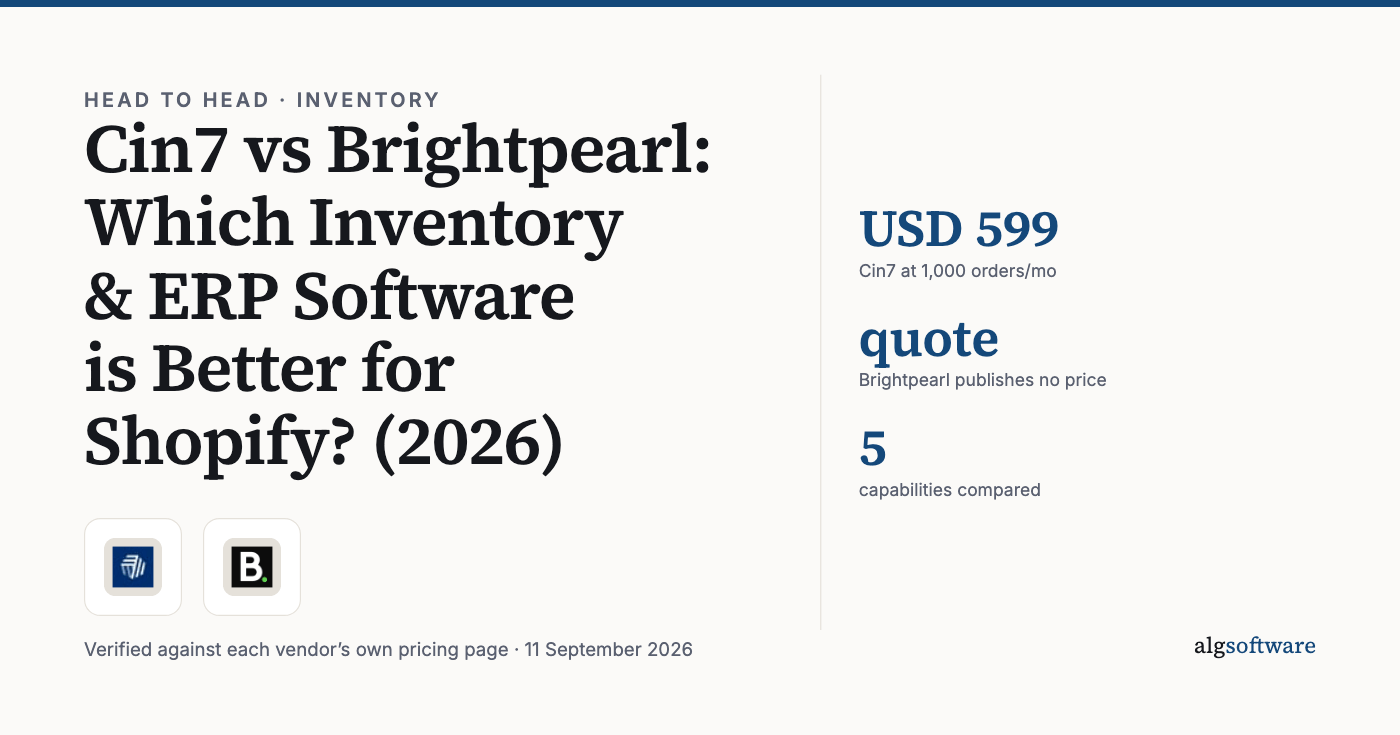
Cin7 vs Brightpearl: Which Inventory & ERP Software is Better for Shopify? (2026)
Links on this page are commercial in intent, at no extra cost to you — they never affect which products we recommend. Read the full disclosure.
Guess the price
Commit to a number before you look. The verified figure comes back with the sentence from the vendor's own pricing page that proves it, and the date we checked it.
Plan 1 of 3
Cin7 — Standard
- Included
- 6,000 orders/year
Show the verified price
USD 349/mo
Standard Ideal for small businesses starting their inventory management journey. $349 /month ... Access for 5 users ... Sale order volume of 6,000/year ... Pro A great choice for growing businesses needing advanced tools. $599 /month ... Access for 10 users ... Sale order volume of 24,000/year ... Advanced Tailored for high-volume businesses with complex operations. $1,199 /month ... Access for 15 users ... Sale order volume of 120,000/year (more available for purchase) ... Omni For enterprises needing fully customizable inventory solutions. CONTACT US FOR PRICING.
Pricing verified 11 Sept 2026 · source
Plan 2 of 3
Cin7 — Pro
- Included
- 24,000 orders/year
Show the verified price
USD 599/mo
Standard Ideal for small businesses starting their inventory management journey. $349 /month ... Access for 5 users ... Sale order volume of 6,000/year ... Pro A great choice for growing businesses needing advanced tools. $599 /month ... Access for 10 users ... Sale order volume of 24,000/year ... Advanced Tailored for high-volume businesses with complex operations. $1,199 /month ... Access for 15 users ... Sale order volume of 120,000/year (more available for purchase) ... Omni For enterprises needing fully customizable inventory solutions. CONTACT US FOR PRICING.
Pricing verified 11 Sept 2026 · source
Plan 3 of 3
Cin7 — Advanced
- Included
- 120,000 orders/year
Show the verified price
USD 1,199/mo
Standard Ideal for small businesses starting their inventory management journey. $349 /month ... Access for 5 users ... Sale order volume of 6,000/year ... Pro A great choice for growing businesses needing advanced tools. $599 /month ... Access for 10 users ... Sale order volume of 24,000/year ... Advanced Tailored for high-volume businesses with complex operations. $1,199 /month ... Access for 15 users ... Sale order volume of 120,000/year (more available for purchase) ... Omni For enterprises needing fully customizable inventory solutions. CONTACT US FOR PRICING.
Pricing verified 11 Sept 2026 · source
Cin7 vs Brightpearl: Finding the Right Inventory & ERP Backbone for Your Shopify Store
If you’re running a growing Shopify business, you’ve probably hit the wall where spreadsheets and basic inventory tools just don’t cut it anymore. Orders are pouring in from multiple channels, warehouse operations are getting complex, and you need real-time visibility across your entire supply chain. That’s where dedicated inventory and ERP platforms like Cin7 and Brightpearl come in.
Both platforms promise to streamline operations for multichannel retailers, but they take noticeably different approaches. In this comparison, we’ll break down exactly how Cin7 and Brightpearl stack up for Shopify merchants — covering features, pricing, ease of use, and which type of business each one serves best.
 Cin7 Overview
Cin7 (now operating under the Cin7 umbrella that includes Cin7 Core and Cin7 Omni) is a cloud-based inventory management platform designed for product sellers. It connects your sales channels — including Shopify — with warehouses, 3PLs, and suppliers in a single system. Cin7 has built its reputation on flexibility: it supports B2B and B2C selling, integrates with a wide ecosystem of apps, and offers both simple and advanced inventory workflows.
Key Features of Cin7
- Multichannel inventory sync: Real-time stock updates across Shopify, Amazon, eBay, and other marketplaces.
- Order management: Centralized order processing with automated routing and fulfillment workflows.
- Warehouse management: Built-in WMS with barcode scanning, pick-pack-ship, and bin/location tracking.
- B2B portal: A dedicated wholesale ordering portal for trade customers.
- EDI connections: Built-in EDI for big-box retailer compliance (Walmart, Costco, etc.).
- Integrations: Native connections to Shopify, Xero, QuickBooks, ShipStation, and 700+ other apps.
- Production/manufacturing: Bill of materials (BOM), production orders, and assembly tracking.
Cin7 Pros & Cons
| Pros | Cons |
|---|---|
| Excellent multichannel inventory sync | Steeper learning curve for advanced features |
| Strong B2B and wholesale capabilities | UI can feel dated in certain modules |
| Built-in EDI for retail compliance | Customer support responsiveness varies by plan |
| Flexible manufacturing and BOM support | Pricing can escalate with add-ons and higher tiers |
| Wide integration ecosystem (700+ apps) | Reporting could be more customizable |
 Brightpearl Overview
Brightpearl, now a Sage company, positions itself as a Retail Operating System rather than just an inventory tool. It’s purpose-built for retail and wholesale businesses and combines inventory management, order processing, accounting, purchasing, CRM, and warehouse management into one unified platform. Brightpearl has historically targeted mid-market merchants doing $1M+ in revenue, and its Shopify integration is one of its flagship connectors.
Key Features of Brightpearl
- Native accounting: Full double-entry accounting built in — no need for a separate Xero or QuickBooks subscription.
- Automation engine: Powerful rules-based automation for order routing, invoicing, fulfillment, and payments.
- Demand planning: Forecasting and purchasing recommendations based on sales velocity and lead times.
- CRM: Built-in customer relationship management tied directly to orders and inventory.
- Warehouse management: Multi-warehouse support with configurable fulfillment workflows.
- Shopify Plus integration: Deep, officially recommended integration for Shopify Plus merchants handling high volume.
- Real-time reporting: Dashboards and reports across sales, inventory, purchasing, and finance.
Brightpearl Pros & Cons
| Pros | Cons |
|---|---|
| True all-in-one ERP with native accounting | Higher price point — designed for mid-market budgets |
| Powerful automation engine saves hours of manual work | Less suitable for very small businesses or startups |
| Excellent Shopify Plus partnership and integration depth | Implementation can take weeks with onboarding required |
| Built-in demand planning and forecasting | Customization options more limited than open API-first tools |
| Backed by Sage — long-term stability and development | Accounting module may be redundant if you already have a preferred system |
Cin7 vs Brightpearl: Head-to-Head Feature Comparison
Let’s look at how these two platforms compare across the categories that matter most to Shopify merchants.
| Feature | Cin7 | Brightpearl |
|---|---|---|
| Shopify Integration | Native integration; supports Shopify and Shopify Plus | Deep Shopify Plus integration; officially recommended partner |
| Inventory Management | Advanced multichannel sync, bundles, variants, serial tracking | Multi-location, demand planning, automated reorder points |
| Accounting | Integrates with Xero, QuickBooks, MYOB | Full built-in accounting (GL, AP, AR) |
| Warehouse Management | Built-in WMS with barcode scanning and bin locations | Multi-warehouse with configurable fulfillment workflows |
| B2B / Wholesale | Dedicated B2B portal and wholesale pricing | Wholesale order management with CRM integration |
| Manufacturing | BOM, production orders, assembly workflows | Basic assembly; not a core focus |
| Automation | Workflow automation for orders and purchasing | Advanced rules-based automation engine across all modules |
| EDI | Built-in EDI module | Available through third-party integrations |
| Best For | SMBs and growing brands needing flexible inventory control | Mid-market retailers needing a unified retail operating system |
Shopify Integration: How Do They Compare?
Both platforms integrate with Shopify, but the depth and focus differ. Brightpearl has a notably tight relationship with Shopify Plus and is listed as a recommended app for high-volume Plus merchants. Its integration handles high-order-volume syncing gracefully and supports advanced Shopify features like multi-currency and multi-location inventory out of the box.
Cin7 also offers a solid native Shopify integration that works for both standard Shopify and Shopify Plus stores. It syncs products, orders, and inventory levels in real time. Where Cin7 shines is its breadth — if you’re selling on Shopify plus Amazon, eBay, your own B2B portal, and through retail partners via EDI, Cin7 connects all of those from one hub.
Key Takeaway: If Shopify Plus is your primary channel and you need an ERP-grade backend, Brightpearl’s integration depth is hard to beat. If you’re selling across many channels beyond Shopify, Cin7 offers broader marketplace connectivity.
Pricing: Cin7 vs Brightpearl
Pricing is one of the biggest differentiators between these two platforms, and it often determines which one is the right fit.
- Cin7 offers tiered pricing starting with Cin7 Core (aimed at smaller businesses) and Cin7 Omni (for more complex operations). Cin7 Core plans generally start in the low hundreds per month, while Cin7 Omni pricing is custom-quoted based on your requirements. This makes Cin7 accessible to businesses at an earlier growth stage.
- Brightpearl does not publish fixed pricing on its website. It uses custom quotes based on revenue, order volume, and the modules you need. Generally, Brightpearl is positioned at a premium price point and targets businesses doing $1M+ in annual revenue. Expect a meaningful upfront implementation cost as well.
For Shopify merchants who are still scaling and budget-conscious, Cin7 is typically the more affordable entry point. Brightpearl becomes cost-effective when you factor in the savings from consolidating accounting, CRM, and inventory into one system — replacing multiple separate subscriptions.
Ease of Use & Implementation
Cin7 can be set up relatively quickly, especially on the Core tier. It offers self-service onboarding resources, though more complex Omni implementations may require guided setup. The interface is functional but can feel dense when configuring advanced workflows like manufacturing or EDI.
Brightpearl typically involves a structured onboarding process with a dedicated implementation team. This adds time and cost upfront but means your system is configured correctly from day one. For merchants with complex operations — multiple warehouses, high SKU counts, and custom fulfillment rules — this guided approach reduces the risk of misconfiguration.
Who Should Choose Cin7?
Cin7 is a strong fit if you:
- Are a small-to-mid-sized Shopify seller looking for robust inventory management
- Sell across multiple channels (Shopify, Amazon, eBay, wholesale) and need centralized stock control
- Need manufacturing or assembly features (BOM, production tracking)
- Require built-in EDI for retail partners like Walmart or Target
- Want a more affordable entry point with room to scale up
- Already use and prefer external accounting software like Xero or QuickBooks
Who Should Choose Brightpearl?
Brightpearl is a strong fit if you:
- Are a mid-market Shopify Plus merchant processing high order volumes
- Want a unified system that covers inventory, orders, accounting, and CRM in one place
- Need sophisticated automation to reduce manual processes across your operations
- Value demand planning and purchasing intelligence to optimize cash flow
- Are ready to invest in a structured implementation for long-term operational efficiency
- Plan to scale significantly and need a platform that won’t buckle under growth
Cin7 Alternatives Worth Considering
If neither Cin7 nor Brightpearl feels like the perfect match, here are a few other Cin7 alternatives that Shopify merchants commonly evaluate:
- Linnworks: A multichannel commerce platform strong in order management and shipping automation.
- Katana: A cloud manufacturing ERP popular with D2C brands that make their own products.
- Extensiv (formerly Skubana): Focused on distributed inventory and multi-warehouse operations.
- NetSuite: A full enterprise ERP for larger businesses that have outgrown mid-market tools entirely.
The Verdict: Cin7 vs Brightpearl for Shopify
Key Takeaway: There’s no universal winner here — the right choice depends on your business stage, budget, and operational complexity. Both are proven platforms trusted by thousands of ecommerce brands.
Choose Cin7 if you need a flexible, cost-effective inventory management platform that connects Shopify with a wide range of other sales channels, handles B2B and manufacturing workflows, and integrates with your existing accounting stack. It’s the better starting point for growing brands that want powerful inventory control without committing to a full ERP.
Choose Brightpearl if you’re a scaling or established Shopify Plus merchant ready for a comprehensive retail operating system. Its built-in accounting, advanced automation, and demand planning capabilities make it ideal for brands that want to consolidate their tech stack into one unified platform — and have the budget and order volume to justify the investment.
Whichever platform you choose, the most important thing is moving beyond disconnected tools and spreadsheets. Both Cin7 and Brightpearl will give your Shopify business the operational backbone it needs to scale with confidence.
Try Cin7 Free Try Brightpearl FreeA vendor won't publish its prices. What do you do?
- Skip it — no published price, no shortlist — your answer
- Book the demo anyway — your answer
- Depends how well it fits everything else — your answer
- Ask other merchants what they actually pay — your answer
One tap, no sign-in. We store the count for each option and nothing else — no cookie, no account, no identifier, and nothing you typed. Nothing is saved on your device, so reloading the page asks again.
See the live Inventory leaderboard — every product we have verified in this category, ranked by what it costs at your volume, with every figure dated and sourced.