Easyship vs Sendcloud: Which Shipping Software is Better for Shopify? (2026)
Links on this page are commercial in intent, at no extra cost to you — they never affect which products we recommend. Read the full disclosure.
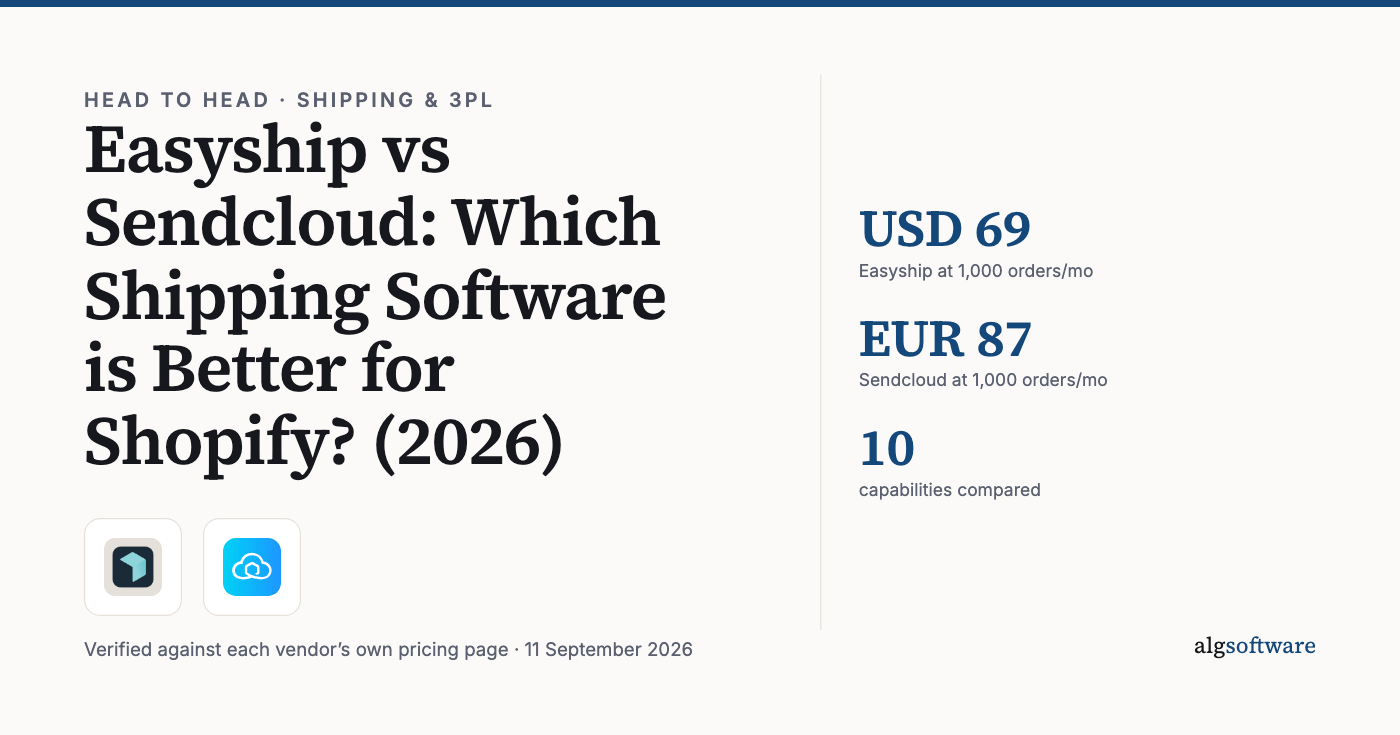
What will this cost you?
| Product | Plan | Published price |
|---|---|---|
| Easyship | Free | USD 0/mo |
| Easyship | Plus | USD 29/mo |
| Easyship | Premier | USD 69/mo |
| Easyship | Scale | USD 99/mo |
| Sendcloud | Free | EUR 0/mo |
| Sendcloud | Lite | EUR 28/mo + EUR 0.1/order |
| Sendcloud | Growth | EUR 87/mo + EUR 0.09/order |
| Sendcloud | Premium | EUR 175/mo + EUR 0.08/order |
| Sendcloud | Pro | EUR 639/mo + EUR 0.07/order |
| Sendcloud | Enterprise | Contact vendor |
Pricing verified 11 Sept 2026 · source
Pricing verified 11 Sept 2026 · source
Shipping can make or break an ecommerce business. For Shopify merchants juggling carrier rates, international duties, and customer expectations around delivery speed, choosing the right shipping platform is a strategic decision — not just an operational one.
Easyship and Sendcloud are two platforms that consistently appear on shortlists for Shopify shipping solutions. Both promise to simplify fulfillment, reduce costs, and improve the post-purchase experience. But they approach the problem from different angles, serve slightly different audiences, and vary significantly in areas like global reach, pricing transparency, and carrier breadth.
In this comparison, we evaluate both platforms across the dimensions that matter most to Shopify store owners in 2026 — so you can make a confident, informed decision.
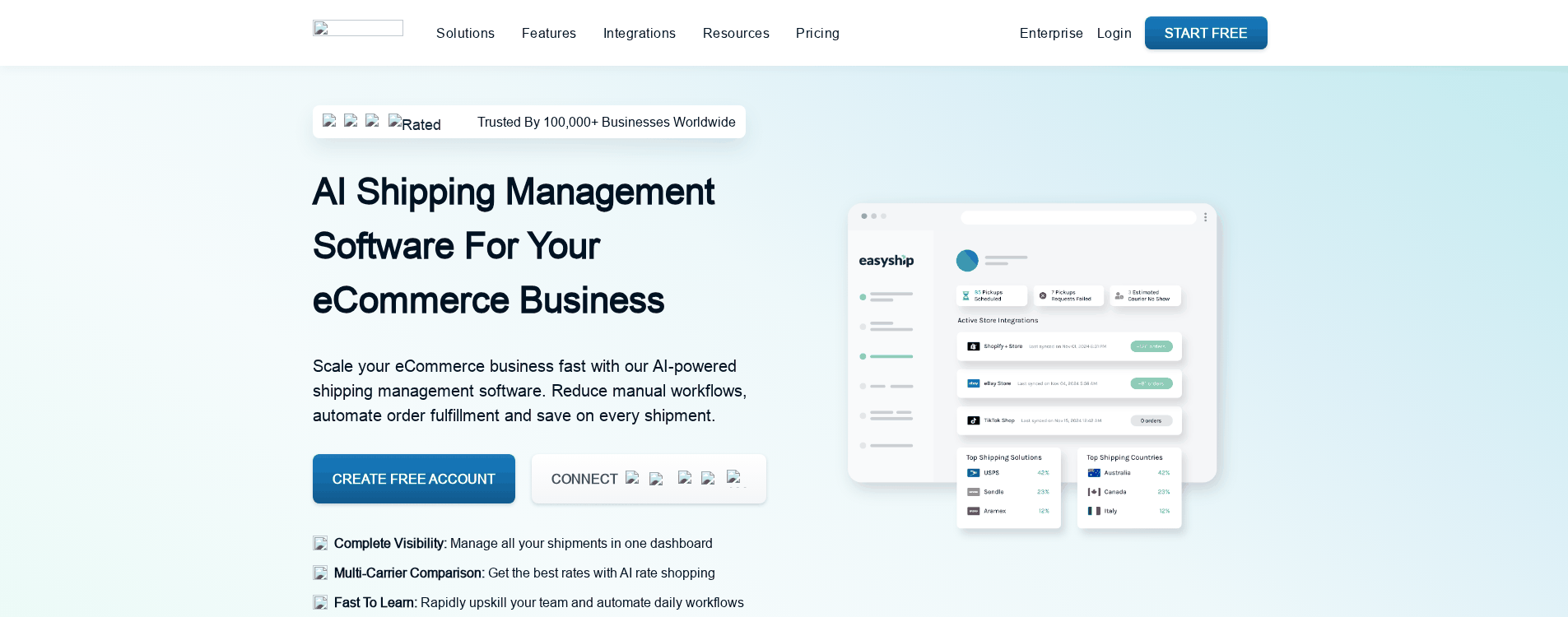
 Easyship Overview
Founded in 2014 and headquartered in New York, Easyship is a cloud-based shipping platform designed to help ecommerce businesses access pre-negotiated shipping rates from a global network of couriers. The platform is particularly well known for its duties-and-taxes calculator, which lets merchants display fully landed costs at checkout — a major advantage for international sellers.
Easyship integrates natively with Shopify and offers access to over 550 courier services worldwide. The platform supports shipping from warehouses in the US, Europe, Asia, and Australia, making it a natural fit for brands with distributed inventory or a global customer base.
Key Features
- Access to 550+ courier solutions with pre-negotiated rates
- Automated duties, taxes, and landed cost calculations at checkout
- Dynamic rate comparison at checkout for Shopify stores
- Multi-warehouse and multi-origin shipping support
- Branded tracking pages and shipping notifications
- Automated shipping rules and label generation
- Insurance options through the platform
Pros
- Exceptional international shipping support — the landed cost calculator is a standout feature that reduces cart abandonment for cross-border orders
- Massive carrier network — access to 550+ services means you can almost always find a cost-effective route
- Multi-origin fulfillment — ideal for merchants shipping from multiple countries
- Real free plan — up to 50 shipments per month on the free tier, with no subscription fee
Cons
- Interface can feel overwhelming for beginners due to the sheer number of options
- Some pre-negotiated rates are only available at higher plan tiers
- Customer support response times can vary depending on your plan level
- Branded tracking customization is more limited compared to dedicated tracking tools
 Sendcloud Overview
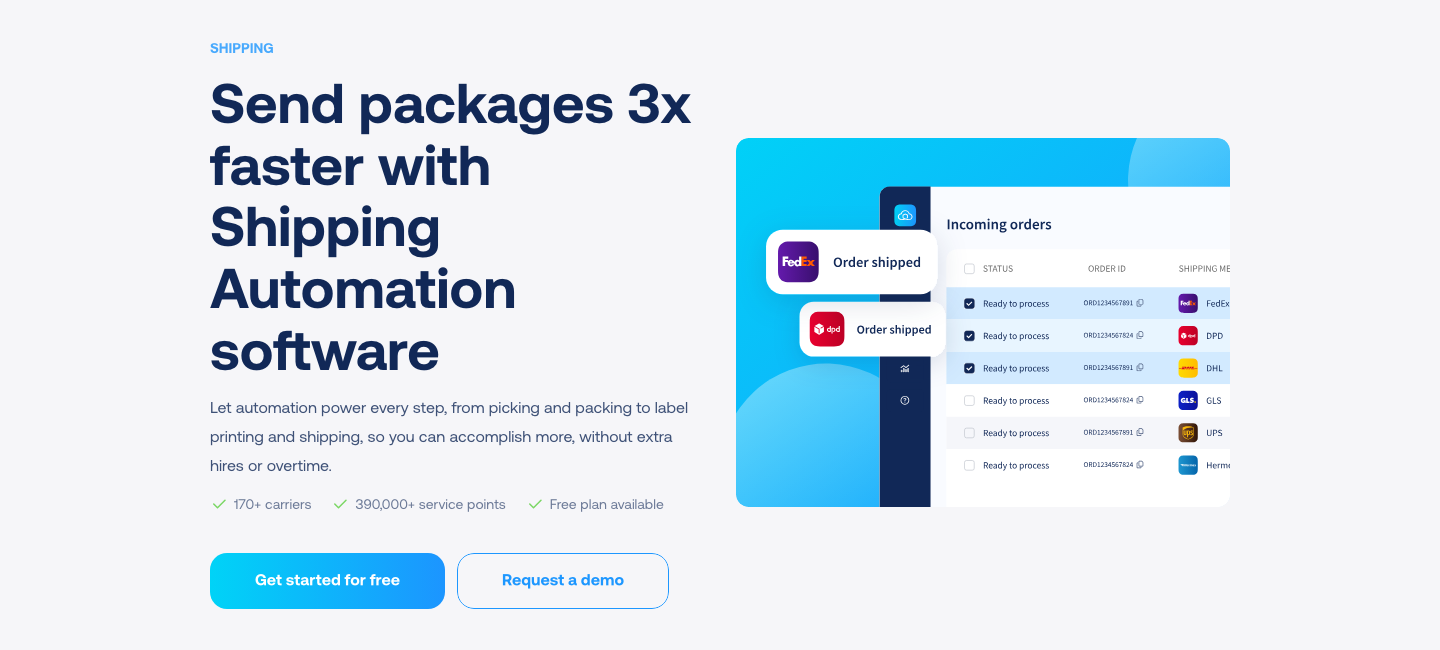
Sendcloud is a European shipping automation platform founded in 2012 in the Netherlands. It has grown into one of the leading shipping solutions for ecommerce businesses operating within Europe, with a strong emphasis on carrier integration, branded returns, and post-purchase customer experience.
Sendcloud connects to a broad network of European carriers including PostNL, DPD, DHL, UPS, Colissimo, and many regional services. The platform provides a centralized dashboard for creating labels, setting up shipping rules, and managing returns — all with a strong focus on the European fulfillment workflow.
Key Features
- Deep integration with major European carriers
- Automated shipping rules based on weight, destination, and order value
- Branded tracking pages with custom domains and messaging
- Self-service return portal for customers
- Pick-and-pack tools for warehouse operations
- Checkout shipping rate optimization for Shopify
- Analytics and shipping performance reporting
Pros
- Best-in-class European carrier network — deep integrations with regional carriers that global platforms often miss
- Excellent branded experience — tracking pages, return portals, and email notifications are highly customizable
- Strong returns management — the self-service return portal is a genuine differentiator for fashion and DTC brands
- Intuitive interface — easier learning curve compared to more complex global platforms
Cons
- Primarily focused on Europe — limited carrier options for merchants shipping from or to Asia, Australia, or Latin America
- No built-in landed cost or duties calculator for international orders
- Free plan is limited to 20 parcels/month, and your own carrier contract only works on a paid plan
- Some advanced automation features are locked behind higher-tier plans
Easyship vs Sendcloud: Feature-by-Feature Comparison
| Feature | Easyship | Sendcloud |
|---|---|---|
| Carrier Network | 550+ global couriers | 170+ carriers, EU-focused (70+ on the free plan) |
| International Shipping | Excellent — duties/taxes calculator, global warehouse support | Good within Europe, limited globally |
| Landed Cost at Checkout | Yes — built-in | No |
| Shopify Integration | Native app with checkout rate display | Native app with checkout integration |
| Branded Tracking | Yes — basic customization | Yes — advanced customization with custom domains |
| Returns Management | Basic return label generation | Full self-service return portal |
| Shipping Rules Automation | Yes | Yes |
| Multi-Warehouse Support | Yes — multiple global origins | Limited |
| Insurance | Built-in shipment insurance | Available through select carriers |
| Free Plan | Up to 50 shipments/month | Up to 20 parcels/month |
Pricing Comparison
Both platforms offer tiered pricing models, but they structure costs differently.
Key Takeaway: The free tiers are not equivalent — Easyship’s covers 50 shipments a month, Sendcloud’s 20 parcels — and the paid ladders diverge faster still, because Sendcloud adds a per-label fee on top of the subscription (€0.10 on Lite, falling to €0.07 on Pro) where Easyship’s plans do not. At 400 labels a month Sendcloud’s €28 Lite plan is really €28 plus €40 of label fees, while Easyship’s $29 Plus plan covers 500 shipments flat. Sendcloud earns that back on European carrier coverage and post-purchase branding, not on sticker price.
Shopify Integration Quality
Both Easyship and Sendcloud offer dedicated Shopify apps available through the Shopify App Store, but the depth of integration differs in a few important ways.
Easyship + Shopify
Easyship’s Shopify app allows merchants to display dynamic shipping rates at checkout, complete with estimated duties and taxes for international orders. Orders sync automatically, and merchants can generate labels directly from the Easyship dashboard. The app also supports Shopify’s multi-location inventory feature, which pairs well with Easyship’s multi-warehouse capabilities.
Sendcloud + Shopify
Sendcloud’s Shopify integration focuses on streamlining the fulfillment workflow. Orders are automatically imported, and merchants can apply shipping rules to auto-select carriers and service levels. The integration supports Shopify’s checkout extensibility for displaying carrier-specific rates. Sendcloud’s edge here is the seamless connection to its branded tracking and returns portal — the entire post-purchase journey can be configured from within the Sendcloud dashboard.
Who Should Choose Easyship?
- International sellers who ship to multiple countries and need accurate landed cost calculations
- Multi-warehouse operations fulfilling from locations across different continents
- Rate shoppers who want access to the widest possible carrier network to minimize shipping costs
- Growing Shopify stores based in the US, Asia-Pacific, or Australia that ship globally
Who Should Choose Sendcloud?
- European-focused merchants who rely on regional carriers like PostNL, DPD, or Colissimo
- DTC and fashion brands that prioritize branded post-purchase experiences and easy returns
- Shopify stores that want an intuitive, quick-to-set-up shipping automation tool
- Businesses with high return rates that need a polished self-service return portal
Alternatives Worth Considering
If neither Easyship nor Sendcloud feels like the right fit, here are a few other shipping platforms popular among Shopify merchants:
- ShipStation — a strong all-rounder with deep carrier integrations in the US and growing international support
- Shippo — developer-friendly with a generous free tier and solid API for custom workflows
- Pirate Ship — best for US-based merchants who want the lowest USPS and UPS rates with zero monthly fees
- ShippyPro — another European option with good carrier coverage and a label-generation focus
Our Verdict
Key Takeaway: There is no single “better” platform — the right choice depends on where you ship, where your customers are, and what post-purchase experience you want to deliver.
If your Shopify store ships internationally and you need to manage duties, taxes, and multi-origin fulfillment, Easyship is the stronger platform. Its landed cost calculator alone can meaningfully reduce cart abandonment on cross-border orders, and the breadth of its carrier network is unmatched.
If your business is primarily European, and you want the best branded tracking, return management, and regional carrier access available, Sendcloud is the better fit. Its focus on the European fulfillment ecosystem means deeper integrations and a smoother experience for both you and your customers within that market.
Both platforms offer free plans, so the most practical next step is to install both Shopify apps, run a few test shipments, and see which workflow feels right for your operation.
Try Easyship Free Try Sendcloud FreeAt your current volume, who packs your orders?
- We do, in-house — your answer
- A 3PL — your answer
- Both — split by product or region — your answer
- We don't ship physical goods — your answer
One tap, no sign-in. We store the count for each option and nothing else — no cookie, no account, no identifier, and nothing you typed. Nothing is saved on your device, so reloading the page asks again.
See the live Shipping & 3PL leaderboard — every product we have verified in this category, ranked by what it costs at your volume, with every figure dated and sourced.