Sendcloud vs Shippo: Which Shipping Software is Better for Shopify? (2026)
Links on this page are commercial in intent, at no extra cost to you — they never affect which products we recommend. Read the full disclosure.
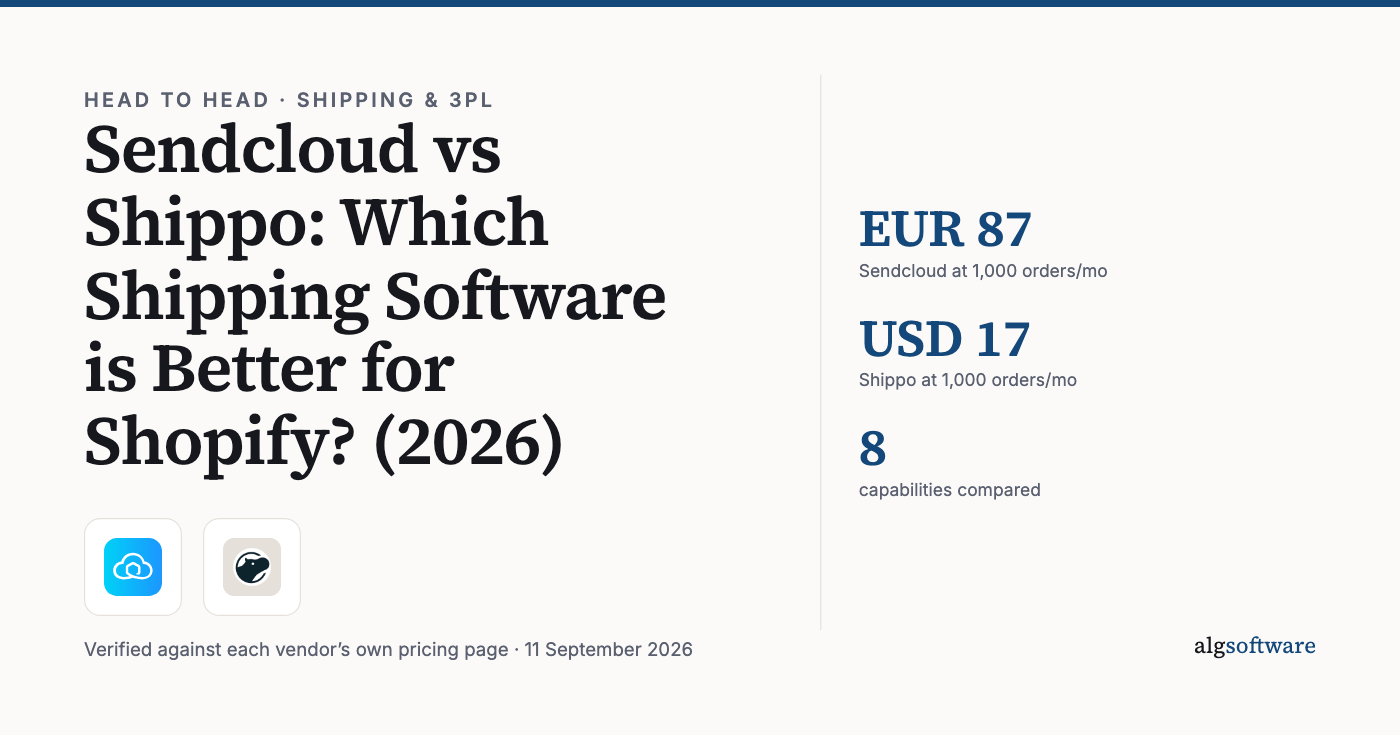
What will this cost you?
| Product | Plan | Published price |
|---|---|---|
| Sendcloud | Free | EUR 0/mo |
| Sendcloud | Lite | EUR 28/mo + EUR 0.1/order |
| Sendcloud | Growth | EUR 87/mo + EUR 0.09/order |
| Sendcloud | Premium | EUR 175/mo + EUR 0.08/order |
| Sendcloud | Pro | EUR 639/mo + EUR 0.07/order |
| Sendcloud | Enterprise | Contact vendor |
| Shippo | Starter | USD 0/mo |
| Shippo | Pro | USD 17/mo + USD 0.08/order |
| Shippo | Premier | Contact vendor |
Pricing verified 11 Sept 2026 · source
Pricing verified 11 Sept 2026 · source
Sendcloud vs Shippo: Which Shipping Software Should Power Your Shopify Store?
If you run a Shopify store, you already know that shipping is more than just slapping a label on a box. The software you choose to manage fulfillment affects your margins, your delivery speed, and ultimately your customer satisfaction. Two platforms that consistently appear on shortlists are Sendcloud and Shippo.
Both promise discounted carrier rates, streamlined label printing, and solid Shopify integrations — but they approach the market from different angles. Sendcloud has deep European roots and specializes in cross-border EU fulfillment, while Shippo was built with the North American merchant in mind and has since expanded globally.
In this comparison, we break down everything that matters: pricing, features, carrier coverage, ease of use, and Shopify-specific functionality so you can make a confident decision.
 Sendcloud Overview
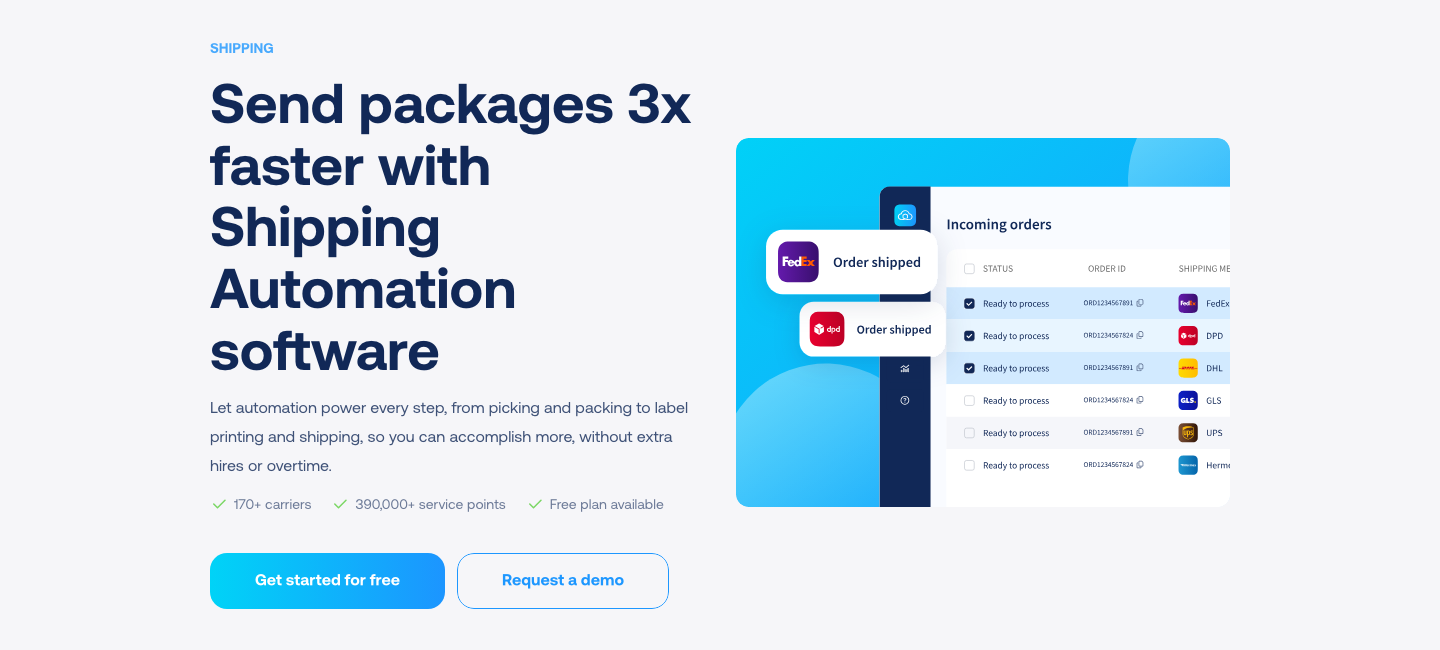
Founded in the Netherlands in 2012, Sendcloud has grown into one of Europe’s leading shipping platforms. It connects with over 100 carriers and serves more than 25,000 online retailers across the continent. The platform is purpose-built for European ecommerce, with native support for EU customs documentation, return portals, and localized tracking pages.
Key Features
- Multi-carrier shipping: Access negotiated rates from carriers like DHL, DPD, UPS, PostNL, Colissimo, and many regional European services.
- Shipping rules engine: Automate carrier selection based on weight, destination, order value, or product type.
- Branded tracking: Customizable tracking pages and email notifications that keep your brand front and center.
- Returns portal: Self-service return flow that you can embed directly in your Shopify store.
- Customs & duties support: Automated generation of customs documents for cross-border EU and international shipments.
- Shopify integration: Direct app with automatic order syncing, bulk label creation, and fulfillment status updates pushed back to Shopify.
Sendcloud Pros & Cons
| Pros | Cons |
|---|---|
| Exceptional European carrier network | Limited carrier options for US domestic shipping |
| Built-in returns portal saves you a separate tool | Free plan stops at 20 parcels a month, and your own carrier contract needs a paid plan |
| Powerful shipping rules automation | Higher-tier plans can get expensive for small stores |
| Strong customs/duties features for cross-border | Customer support response times vary by plan level |
 Shippo Overview
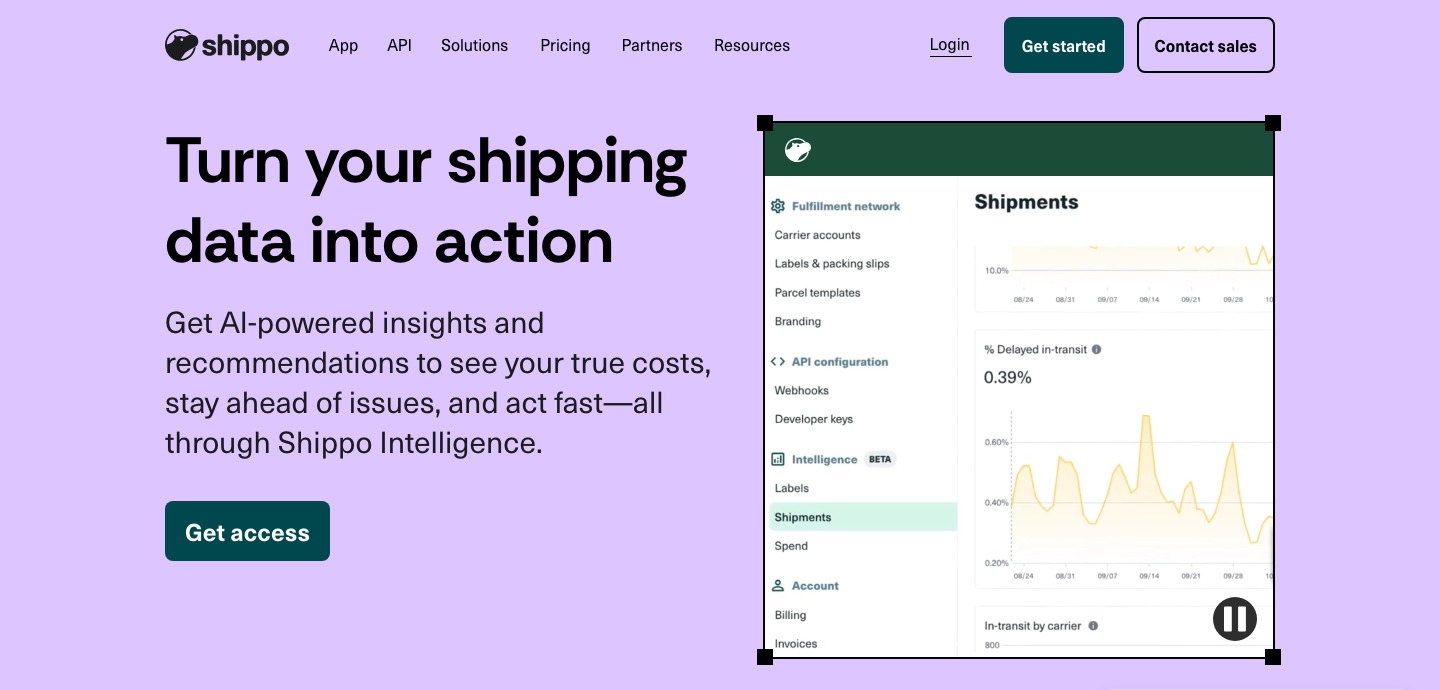
Shippo launched in San Francisco in 2013 and has become one of the most popular shipping APIs and platforms in North America. It offers access to 40+ global carriers and publishes its prices flat — a free Starter plan, then a single $17/mo Pro tier covering up to 10,000 shipments — which makes it particularly attractive to small and mid-sized Shopify merchants who want a number they can budget against before committing.
Key Features
- Discounted USPS, UPS & DHL Express rates: Pre-negotiated rates that can save merchants up to 90% on select services.
- Free Starter plan: No monthly fee and no per-label surcharge, up to 30 shipments a month.
- Shipping API: A developer-friendly REST API for custom integrations and high-volume automation.
- Batch label creation: Print hundreds of labels at once, ideal for stores processing high daily order volumes.
- Address validation: Built-in address verification to reduce failed deliveries and surcharges.
- Shopify integration: One-click install from the Shopify App Store with real-time order import and tracking sync.
Shippo Pros & Cons
| Pros | Cons |
|---|---|
| Free Starter plan and one flat paid tier — no per-label fee, no minimum | European carrier coverage is thinner than Sendcloud |
| Excellent USPS and UPS discounted rates | No built-in branded returns portal |
| Developer-friendly API for custom workflows | Automation rules are less sophisticated than Sendcloud |
| Clean, intuitive dashboard | Per-label costs can add up at very high volumes |
Sendcloud vs Shippo: Feature-by-Feature Comparison
Let’s stack these platforms side by side on the criteria that matter most to Shopify merchants.
| Feature | Sendcloud | Shippo |
|---|---|---|
| Best For | European & cross-border shipping | US domestic & global flexibility |
| Carrier Network | 100+ (EU-focused) | 40+ (US-focused with global reach) |
| Shopify App | Yes — direct integration | Yes — direct integration |
| Pricing Model | Monthly subscription plus a per-label fee | Flat monthly plans — free Starter, then Pro |
| Free Plan | Yes — up to 20 parcels/month | Yes — up to 30 shipments/month |
| Returns Portal | Built-in, branded | Basic — no branded self-service portal |
| Shipping Rules Automation | Advanced (multi-condition rules) | Basic automation available |
| Customs Documentation | Fully automated | Supported |
| API Access | Available on higher plans | Available on all plans |
| Branded Tracking Pages | Yes | Yes (on the Pro plan) |
| Address Validation | Yes | Yes |
Pricing Breakdown
Pricing is often the deciding factor for Shopify merchants evaluating shipping software, and Sendcloud and Shippo take notably different approaches.
Sendcloud Pricing
Sendcloud uses a tiered subscription model with a per-label fee on top of every paid plan. The free plan carries no subscription fee at all and covers 20 parcels a month; above it the published ladder runs Lite, Growth, Premium and Pro, and only the Enterprise tier at the very top is quoted rather than listed.
Carrier rates are separate — you either use Sendcloud’s pre-negotiated rates or connect your own carrier contracts for potentially better pricing.
Shippo Pricing
Shippo’s Starter plan has no monthly fee and no per-label surcharge — it simply stops at 30 shipments a month. That makes it very accessible for new or low-volume Shopify stores. The one per-label charge Shippo does publish is the 5c that applies when you bring your own carrier account.
Key Takeaway: At 400 orders a month Shippo is the cheaper line on paper — one $17 Pro plan against Sendcloud’s €28 Lite plus €0.10 a label, which comes to €68 at that volume. Sendcloud earns the difference back in Europe, where its carrier coverage, checkout delivery options and returns portal do work Shippo has no answer for. It is not winning on price, and it does not need to.
Shopify Integration Quality
Both platforms offer dedicated Shopify apps, but the integration experience differs in a few meaningful ways.
Sendcloud + Shopify
Sendcloud’s Shopify app automatically imports orders and lets you generate labels in bulk directly from the Sendcloud dashboard. Fulfillment status and tracking numbers are pushed back to Shopify in real time. Where Sendcloud really shines is its checkout shipping options — you can display multiple carrier choices and delivery timeframes at checkout, which helps improve conversion rates and manage customer expectations.
Shippo + Shopify
Shippo’s Shopify integration is similarly straightforward. Orders sync automatically, and you can purchase and print labels from the Shippo dashboard or directly within Shopify. Shippo also supports Shopify’s native shipping rate calculation at checkout on the Pro plan. The setup is fast — most merchants are operational within minutes of installing the app.
Both integrations support multi-store setups if you manage more than one Shopify storefront, though Sendcloud handles this more natively on its Growth plan and above.
Carrier Network & Rate Comparison
This is where geography makes a major difference.
Sendcloud offers access to over 100 carriers, with exceptional depth across Europe: PostNL, DPD, DHL (Parcel, Express, eCommerce), Colissimo, Correos, GLS, Hermes, Royal Mail, bpost, and dozens more. If you ship to or within the EU, Sendcloud’s carrier variety and localized services (like parcel shop drop-off networks) are hard to beat.
Shippo offers 40+ carriers with particular strength in the US market. USPS, UPS, FedEx, and DHL Express are all available with pre-negotiated discounts. Shippo has expanded internationally and now supports carriers in Canada, Australia, the UK, and parts of Europe, but the depth of regional European carriers doesn’t match Sendcloud.
Returns Management
Returns can be a profit killer if not managed well. Here, Sendcloud has a clear edge.
Sendcloud includes a branded self-service returns portal that you can embed on your Shopify store. Customers can initiate returns, select a reason, and generate a return label — all without contacting your support team. You can set rules for which products are returnable, define return windows, and choose who pays for the return label.
Shippo supports return label generation, but it lacks a dedicated branded returns portal. You’ll need a third-party returns management tool — Loop Returns is the usual choice, and it absorbed Returnly, which is no longer sold — if you want to offer a polished self-service returns experience alongside Shippo.
Ease of Use
Both platforms are designed for non-technical merchants, but they differ in approach.
Sendcloud packs a lot of power into its dashboard, which can feel slightly overwhelming during initial setup — especially if you’re configuring shipping rules, carrier connections, and branded tracking for the first time. Once set up, however, the day-to-day workflow is smooth and largely automated.
Shippo takes a more minimalist approach. The interface is clean and intuitive from day one, making it easy for new merchants to start shipping immediately. The trade-off is that some advanced automation features require you to move to the Pro plan or use the API.
Customer Support
Both platforms offer email and chat support, though response quality and speed can vary.
- Sendcloud: Email support on all plans, with live chat and priority support reserved for higher tiers. They also offer an extensive knowledge base and onboarding assistance for Growth and Premium customers.
- Shippo: Email support is standard, with live chat available on the Pro plan. Shippo’s help center and developer documentation are comprehensive and well-organized.
Who Should Choose Sendcloud?
- Shopify merchants based in Europe or shipping primarily to EU destinations
- Stores that need advanced shipping rules and automation
- Brands that want a built-in, branded returns portal
- Businesses shipping cross-border within Europe and need automated customs documentation
- Mid-to-high volume merchants who benefit from subscription-based pricing
Who Should Choose Shippo?
- US-based Shopify merchants shipping domestically
- New or low-volume stores that want a genuinely free plan with no monthly commitment
- Developer-led teams that want API-first shipping infrastructure
- Merchants who value a simple, fast setup and clean interface
- Stores that already use third-party returns tools and don’t need a built-in portal
Sendcloud vs Shippo: The Verdict
There’s no universal winner here — the best choice depends on where you ship and how you operate.
Choose Sendcloud if your Shopify store operates in or ships heavily to Europe. Its unmatched EU carrier network, powerful shipping rules engine, and integrated returns portal make it the most complete solution for European ecommerce fulfillment. The subscription model rewards growing businesses with better rates and more automation as they scale.
Choose Shippo if you’re a US-based Shopify merchant who values flexibility and simplicity. The free Starter plan takes the financial risk out of trying it, the USPS and UPS discounts are genuinely competitive, and the developer-friendly API opens doors for custom workflows as your business grows. It’s also the safer pick if you ship globally but don’t have a concentrated European customer base.
Key Takeaway: For European Shopify merchants, Sendcloud is the specialist tool that will save you time and money. For US-based stores or those wanting maximum pricing flexibility, Shippo delivers an excellent balance of simplicity, affordability, and carrier access. Either way, both platforms offer free plans — so the best next step is to install both Shopify apps and test them with a few real orders before committing.
| Category | Winner |
|---|---|
| European Shipping | Sendcloud |
| US Domestic Shipping | Shippo |
| Pricing Flexibility | Shippo |
| Returns Management | Sendcloud |
| Automation & Rules | Sendcloud |
| Ease of Setup | Shippo |
| API & Developer Tools | Shippo |
| Shopify Integration | Tie |
Disclaimer: Pricing and feature details are based on publicly available information as of early 2026 and may change. We recommend verifying current plans on each provider’s website.
At your current volume, who packs your orders?
- We do, in-house — your answer
- A 3PL — your answer
- Both — split by product or region — your answer
- We don't ship physical goods — your answer
One tap, no sign-in. We store the count for each option and nothing else — no cookie, no account, no identifier, and nothing you typed. Nothing is saved on your device, so reloading the page asks again.
See the live Shipping & 3PL leaderboard — every product we have verified in this category, ranked by what it costs at your volume, with every figure dated and sourced.