ShipBob vs Easyship: Which Shipping Software is Better for Shopify? (2026)
Links on this page are commercial in intent, at no extra cost to you — they never affect which products we recommend. Read the full disclosure.
What will this cost you?
| Product | Plan | Published price |
|---|---|---|
| ShipBob | — | Quote-based — contact vendor |
| Easyship | Free | USD 0/mo |
| Easyship | Plus | USD 29/mo |
| Easyship | Premier | USD 69/mo |
| Easyship | Scale | USD 99/mo |
Pricing verified 11 Sept 2026 · source
Pricing verified 11 Sept 2026 · source
ShipBob vs Easyship: A Head-to-Head Comparison for Shopify Sellers
If you run a Shopify store, you already know that shipping is one of the most operationally complex—and margin-sensitive—parts of your business. The software you choose to manage fulfillment can directly impact delivery speed, customer satisfaction, and your bottom line.
Two platforms that consistently appear in the conversation are ShipBob and Easyship. Both integrate with Shopify, both promise to simplify shipping, and both have loyal user bases. But they serve fundamentally different needs. ShipBob is a third-party logistics (3PL) provider with its own warehouse network, while Easyship is a shipping management platform that aggregates carrier rates and lets you handle fulfillment yourself.
In this guide, we break down features, pricing, and integrations so you can make an informed decision.
 ShipBob Overview
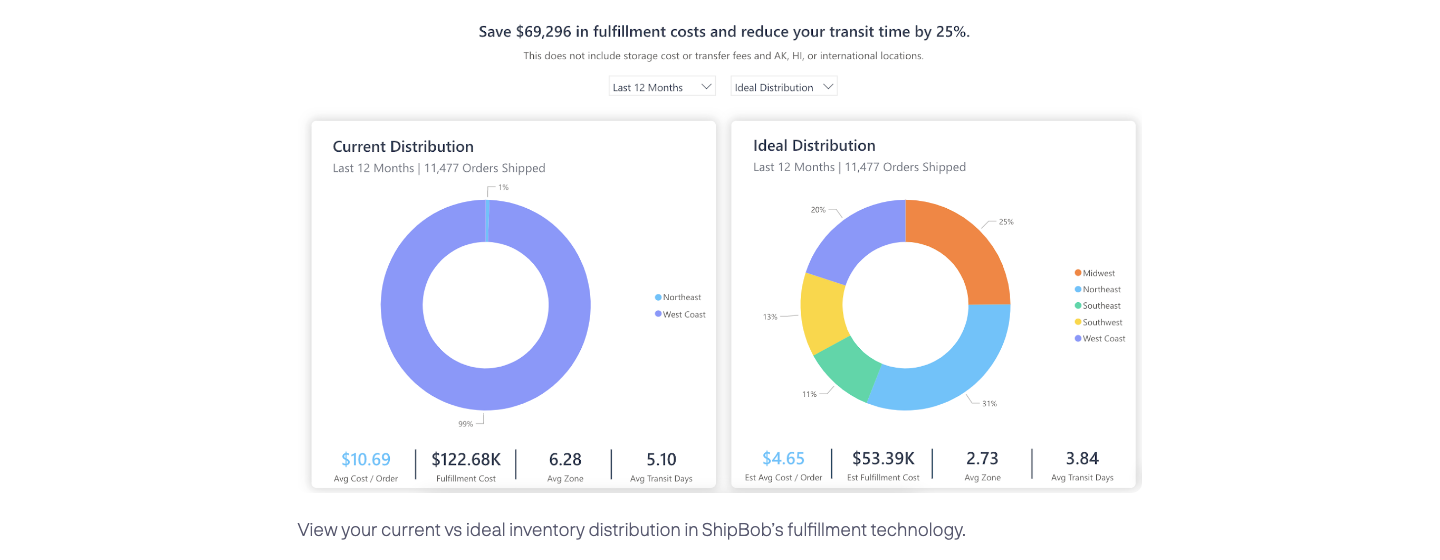
ShipBob is a tech-enabled 3PL that stores, picks, packs, and ships your inventory from a network of fulfillment centers across the United States, Canada, the UK, the EU, and Australia. When a Shopify order comes in, ShipBob’s warehouse team handles everything—your job is simply to keep inventory stocked.
Founded in 2014, ShipBob has grown into one of the most recognized fulfillment partners for direct-to-consumer (DTC) brands. The platform offers a proprietary dashboard for inventory management, order tracking, and analytics, plus a native Shopify integration that syncs orders in real time.
ShipBob Key Features
- Distributed fulfillment network: Ship from multiple warehouses to reduce transit times and shipping costs.
- 2-day shipping program: Compete with Amazon Prime-style delivery through ShipBob’s optimized routing.
- Inventory management dashboard: Real-time stock levels, reorder notifications, and demand forecasting.
- B2B and wholesale fulfillment: Support for retail distribution and EDI compliance.
- Custom packaging and kitting: Branded unboxing experiences and subscription box assembly.
- Returns management: Automated return processing through integrated RMA workflows.
ShipBob Pros & Cons
Pros:
- Hands-off fulfillment—no need to manage a warehouse or shipping staff
- Multi-location inventory distribution for faster delivery
- Strong Shopify integration with automatic order syncing
- Transparent analytics dashboard with real-time shipment tracking
- Scales well for growing DTC brands shipping hundreds to thousands of orders per month
Cons:
- Higher per-order costs compared to self-fulfillment
- Less control over the packing and shipping process
- Minimum order volume expectations may not suit very small or new stores
- Onboarding and inventory transfer can take time
- Storage fees can add up for slow-moving SKUs
 Easyship Overview
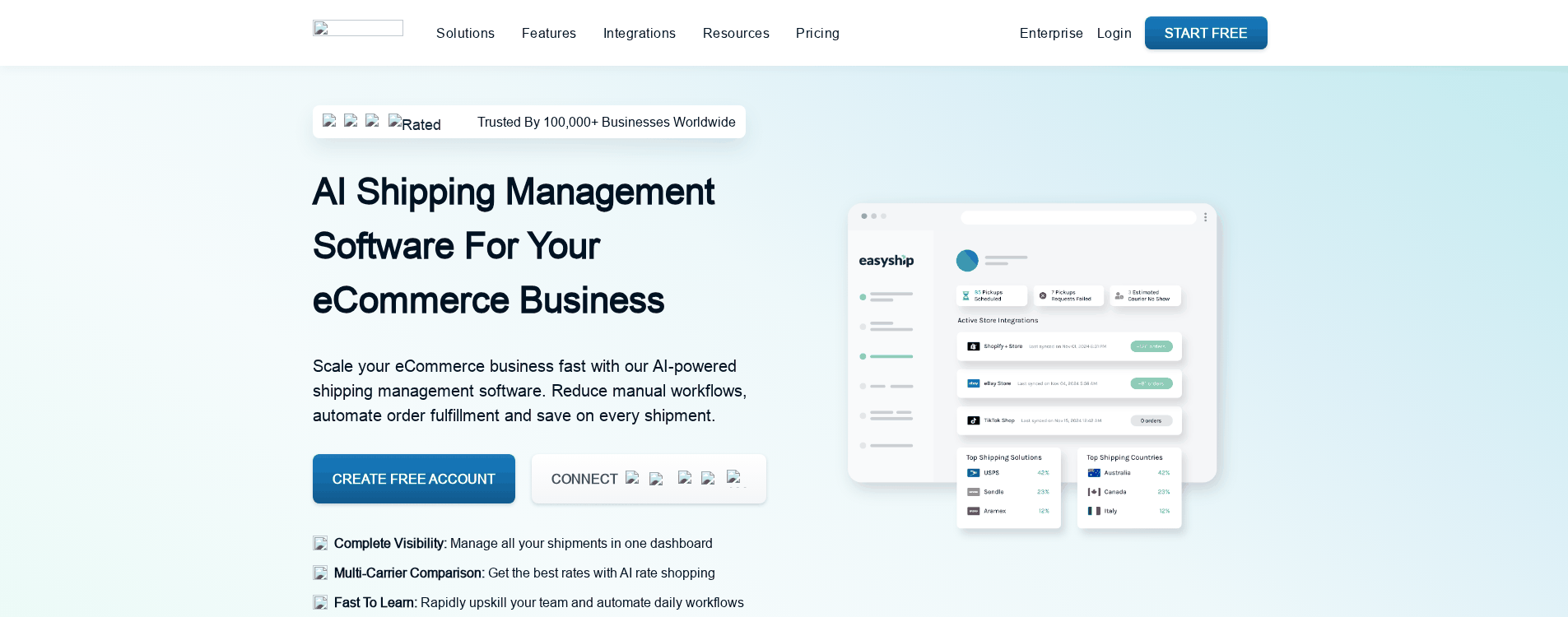
Easyship takes a different approach. Rather than handling your inventory and fulfillment, it acts as a shipping management platform that connects you to 550+ courier services worldwide—giving you access to pre-negotiated discounted rates from carriers like USPS, UPS, FedEx, DHL, and dozens of regional providers.
Founded in 2014 and headquartered in New York, Easyship is built for merchants who want to ship from their own warehouse, office, or workshop while still getting enterprise-level carrier discounts. The platform handles rate comparison, label generation, customs documentation for international orders, tracking, and branded shipping notifications.
Easyship Key Features
- Rate comparison engine: Instantly compare rates from 550+ courier solutions to find the cheapest or fastest option.
- Pre-negotiated discounts: Access up to 91% off retail shipping rates without volume commitments.
- Automated duties and taxes: Calculate landed costs at checkout so international customers see the full price upfront.
- Branded tracking pages: Custom tracking experiences with your store’s branding.
- Shipping rules automation: Set rules to auto-select carriers based on weight, destination, or order value.
- Global coverage: Ship to 220+ countries with automatic customs form generation.
Easyship Pros & Cons
Pros:
- Significant carrier discounts without minimum volume requirements
- Excellent for international and cross-border shipping
- Full control over your inventory and fulfillment process
- Free plan available for stores shipping up to 50 shipments per month
- Automated duties and taxes calculator reduces cart abandonment for global orders
Cons:
- You still handle packing and warehouse operations yourself
- No fulfillment infrastructure—purely a software layer
- Advanced features (shipping rules, multiple users) require paid plans
- Customer support response times can be slower on lower-tier plans
- Rate discounts vary by region and carrier availability
ShipBob vs Easyship: Feature Comparison Table
| Feature | ShipBob | Easyship |
|---|---|---|
| Type | 3PL / Fulfillment Provider | Shipping Management Platform |
| Warehouse & Fulfillment | Yes — fully managed | No — self-fulfilled |
| Shopify Integration | Native app | Native app |
| Carrier Access | ShipBob-negotiated rates | 550+ couriers with discounts |
| International Shipping | Via global fulfillment centers | 220+ countries with duties/taxes calc |
| 2-Day Shipping | Yes — via distributed network | Depends on carrier/location |
| Free Plan | No — custom pricing | Yes — up to 50 shipments/month |
| Returns Management | Built-in RMA processing | Basic return label generation |
| Best For | DTC brands already shipping volume | Self-fulfilling merchants & global sellers |
Pricing: ShipBob vs Easyship
Pricing is where these two platforms diverge most sharply, largely because they offer fundamentally different services.
ShipBob Pricing
ShipBob uses custom pricing based on your order volume, product dimensions, storage needs, and fulfillment center locations. Typical cost components include:
- Receiving fees: Per-unit or per-hour charges for processing inbound inventory
- Storage fees: Monthly charges based on shelf, bin, or pallet space used
- Pick and pack fees: Per-order fulfillment charges (first pick often included)
- Shipping costs: Passed through at ShipBob’s negotiated carrier rates
There is no publicly listed monthly subscription. You will need to request a custom quote, which means ShipBob is harder to evaluate without a sales conversation.
Easyship Pricing
On top of the subscription, you pay the discounted carrier rates for each shipment. Because Easyship doesn’t handle warehousing, there are no storage or pick-and-pack fees.
Key Takeaway: Easyship has the lower barrier to entry, and a decisive one — it publishes its prices, so you can cost it out before committing to anything. ShipBob will not give you a number without a sales conversation, and the number it eventually gives you is different in kind: it absorbs warehouse operations you would otherwise run and pay for yourself.
Shopify Integration Experience
Both platforms offer native Shopify apps, but the integration experience differs based on what each tool does.
ShipBob’s Shopify integration automatically pulls orders and sends them to the nearest fulfillment center. Tracking numbers sync back to Shopify, and customers receive shipping notifications. Inventory levels are managed through ShipBob’s dashboard and reflect in Shopify in real time. Setup requires transferring your inventory to ShipBob’s warehouses, which involves an onboarding process.
Easyship’s Shopify integration imports orders into the Easyship dashboard where you compare rates, print labels, and schedule pickups. It also offers a checkout rate calculator widget that displays real-time shipping costs to customers before they complete their purchase—a powerful tool for reducing cart abandonment. Setup is faster since you are shipping from your existing location.
Who Should Choose ShipBob?
- Growing DTC brands shipping 100+ orders per month that want to focus on marketing and product development rather than packing boxes
- Businesses needing 2-day shipping to compete with Amazon and large retailers
- Multi-channel sellers who want a single fulfillment partner across Shopify, Amazon, Walmart, and other marketplaces
- Brands with complex fulfillment needs like subscription boxes, kitting, or custom packaging
- Companies planning to scale and wanting infrastructure that grows without hiring warehouse staff
Who Should Choose Easyship?
- New or small Shopify stores that aren’t ready to outsource fulfillment but want better shipping rates
- International sellers who ship frequently across borders and need automated customs documentation
- Merchants who want full control over their packing, branding, and shipping workflow
- Budget-conscious businesses looking for a free or low-cost entry point
- Niche or handmade product sellers who add personal touches to each package
ShipBob Alternatives to Consider
If neither ShipBob nor Easyship feels like the right fit, here are other popular ShipBob alternatives worth evaluating:
- ShipStation: A shipping label and order management platform (similar to Easyship) with strong multi-carrier support and automation rules.
- Deliverr (now Flexport): A 3PL competitor to ShipBob offering fast, affordable fulfillment with Walmart and Amazon badge eligibility.
- Pirate Ship: A free shipping software that offers USPS and UPS discounts—great for very small Shopify stores.
- Red Stag Fulfillment: A 3PL specializing in heavy, oversized, or high-value products.
Our Verdict: ShipBob vs Easyship for Shopify
Key Takeaway: These two platforms solve different problems. ShipBob replaces your warehouse; Easyship optimizes your shipping from it. The right choice depends on whether you want to outsource fulfillment or keep it in-house.
Choose ShipBob if you are ready to hand off fulfillment entirely. You are scaling fast, spending too much time on logistics, and need warehouse infrastructure without building it yourself. ShipBob’s distributed network and 2-day shipping capabilities make it a strong choice for brands that prioritize delivery speed and operational simplicity.
Choose Easyship if you want to keep shipping in your own hands while accessing enterprise-level carrier discounts. It is especially compelling for international sellers, budget-conscious startups, and merchants who value control over every package that leaves their facility. The free plan makes it easy to test before committing.
For many Shopify merchants, the decision comes down to scale and control. Early-stage stores often start with Easyship and graduate to ShipBob as order volume grows and self-fulfillment becomes a bottleneck. There is no wrong answer—only the right fit for where your business is today.
Try ShipBob FreeTry Easyship Free
This comparison was last updated in March 2026. Pricing and features may have changed since publication. ALG Software recommends verifying details on each provider’s official website before making a purchasing decision.
At your current volume, who packs your orders?
- We do, in-house — your answer
- A 3PL — your answer
- Both — split by product or region — your answer
- We don't ship physical goods — your answer
One tap, no sign-in. We store the count for each option and nothing else — no cookie, no account, no identifier, and nothing you typed. Nothing is saved on your device, so reloading the page asks again.
See the live Shipping & 3PL leaderboard — every product we have verified in this category, ranked by what it costs at your volume, with every figure dated and sourced.