ShipBob vs Shippo: Which Shipping Software is Better for Shopify? (2026)
Links on this page are commercial in intent, at no extra cost to you — they never affect which products we recommend. Read the full disclosure.
What will this cost you?
| Product | Plan | Published price |
|---|---|---|
| ShipBob | — | Quote-based — contact vendor |
| Shippo | Starter | USD 0/mo |
| Shippo | Pro | USD 17/mo + USD 0.08/order |
| Shippo | Premier | Contact vendor |
Pricing verified 11 Sept 2026 · source
Pricing verified 11 Sept 2026 · source
ShipBob vs Shippo: Which Shipping Platform Wins for Shopify Sellers?
If you run a Shopify store, you already know that shipping is one of the most complex — and most critical — parts of your operation. Get it right and you earn loyal customers. Get it wrong and you’re drowning in refund requests and one-star reviews.
Two names consistently rise to the top when Shopify merchants search for shipping solutions: ShipBob and Shippo. But despite both occupying the “shipping software” category, they solve fundamentally different problems. ShipBob is a full-service third-party logistics (3PL) provider, while Shippo is a multi-carrier shipping API and label platform.
In this head-to-head comparison, we’ll help you decide which one is better suited for your Shopify business based on your order volume, fulfillment model, and growth plans.
 ShipBob Overview
ShipBob is a tech-enabled third-party logistics (3PL) company that handles warehousing, picking, packing, and shipping for ecommerce brands. Founded in 2014, the platform has grown into one of the most widely used fulfillment partners for direct-to-consumer Shopify stores.
Rather than simply generating shipping labels, ShipBob physically stores your inventory across its network of fulfillment centers in the US, Canada, Europe, and Australia. When a Shopify order comes in, ShipBob’s warehouse team picks, packs, and ships it on your behalf.
ShipBob Key Features
- Distributed Fulfillment Network: Store inventory across multiple warehouses to reduce delivery times and shipping costs.
- Native Shopify Integration: Orders sync automatically from your Shopify store to ShipBob’s dashboard in real time.
- Inventory Management: Built-in tools for tracking stock levels, setting reorder points, and forecasting demand.
- 2-Day Express Shipping: ShipBob offers a 2-day shipping program across the continental US to compete with Amazon Prime expectations.
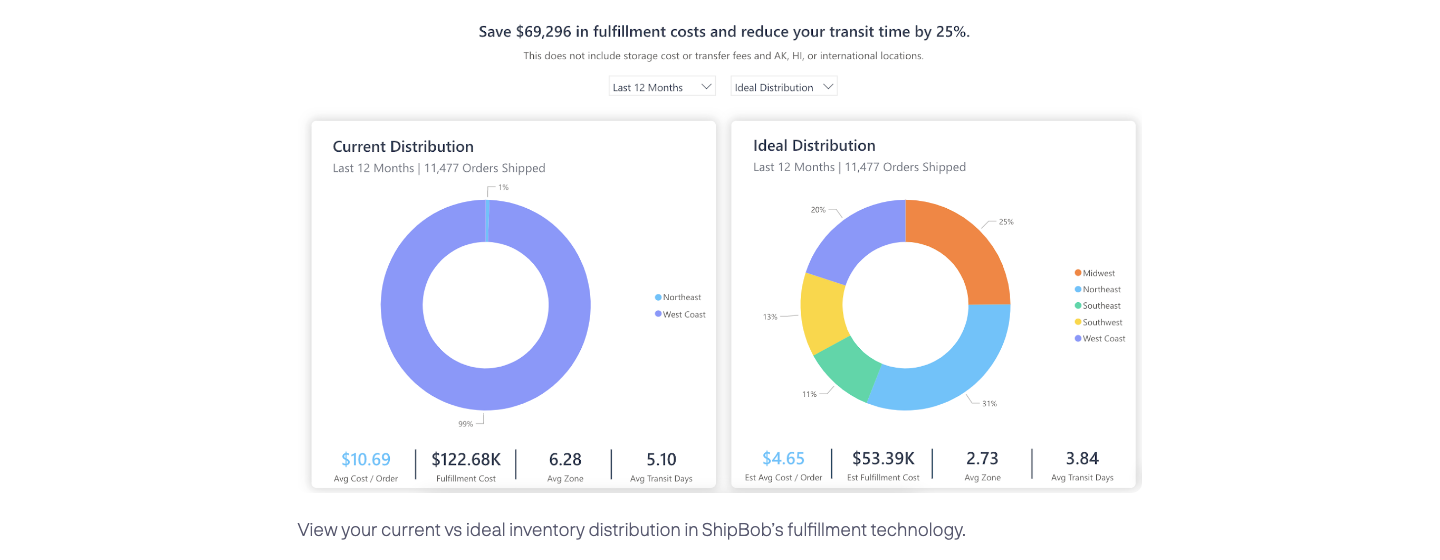
- Analytics Dashboard: Detailed reporting on fulfillment speed, shipping costs, transit times, and inventory performance.
- B2B and Wholesale Support: Handles both DTC and B2B fulfillment workflows from the same platform.
- Returns Management: Automated return processing through the ShipBob dashboard.
ShipBob Pros & Cons
- ✓ Pro: Completely hands-off fulfillment — no need to touch a box or visit a post office.
- ✓ Pro: Multi-warehouse distribution can significantly cut transit times and shipping costs.
- ✓ Pro: Strong Shopify integration with real-time order and inventory syncing.
- ✓ Pro: Scales well for high-volume merchants shipping hundreds or thousands of orders per month.
- ✗ Con: Higher overall cost than self-fulfillment, especially for low-volume stores.
- ✗ Con: Less control over packaging and unboxing experience compared to in-house fulfillment.
- ✗ Con: Onboarding can take several weeks as you ship inventory to their warehouses.
- ✗ Con: Pricing is quote-based and not fully transparent on their website.
 Shippo Overview
Shippo is a multi-carrier shipping platform that helps ecommerce businesses compare rates, purchase discounted labels, and track packages across dozens of carriers. Founded in 2013, Shippo focuses on the label-generation and carrier-management layer of shipping rather than physical fulfillment.
With Shippo, you still pack and ship orders yourself (or through your own warehouse team). The platform connects to your Shopify store, pulls in orders, and lets you quickly generate labels at pre-negotiated discounted rates from carriers like USPS, UPS, FedEx, and DHL.
Shippo Key Features
- Multi-Carrier Rate Comparison: Instantly compare discounted rates across 40+ carriers to find the cheapest or fastest option per package.
- Discounted Shipping Labels: Access pre-negotiated USPS, UPS, and DHL rates without needing your own carrier accounts.
- Shopify Integration: Syncs orders from Shopify and pushes tracking numbers back automatically.
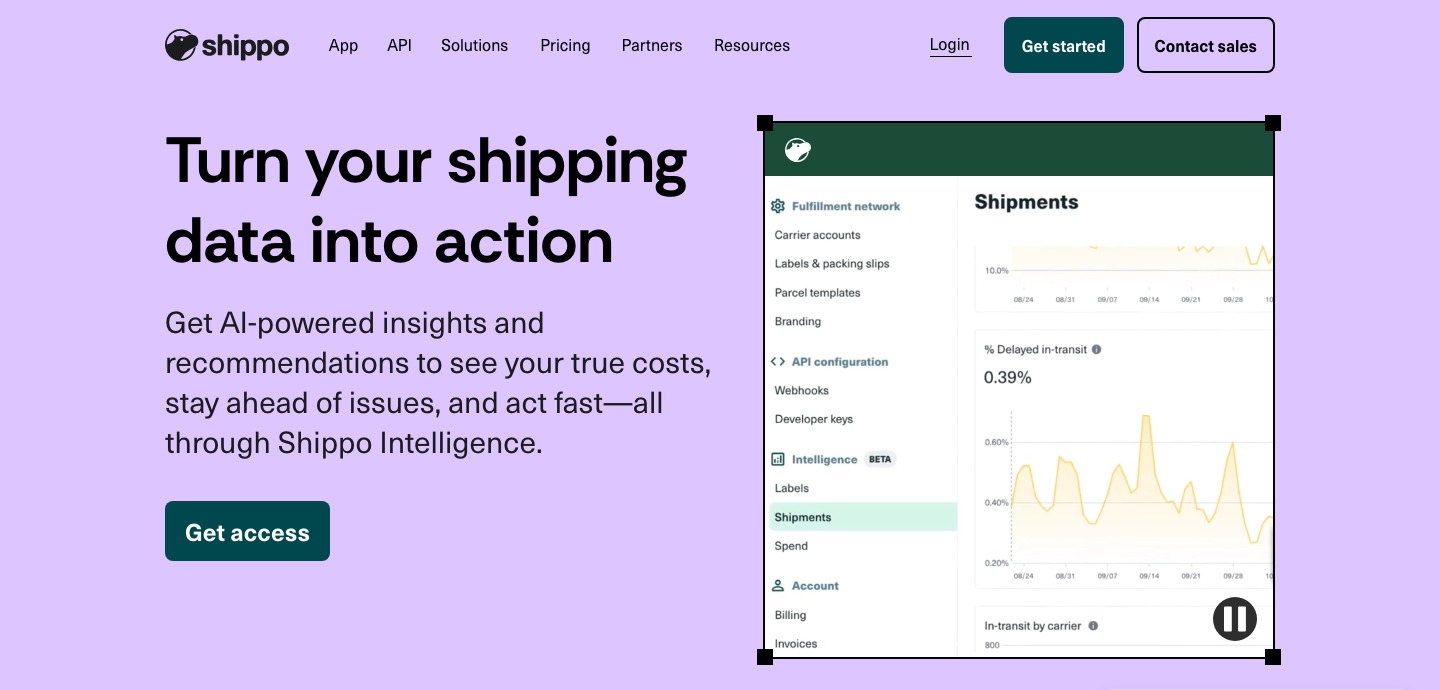
- Shipping API: Developer-friendly REST API for businesses that want to embed shipping functionality into custom workflows.
- Batch Label Printing: Generate hundreds of labels at once for high-volume shipping days.
- Address Validation: Automatically verifies and corrects shipping addresses to reduce failed deliveries.
- Branded Tracking Pages: Custom tracking pages with your store’s branding instead of generic carrier pages.
Shippo Pros & Cons
- ✓ Pro: Free tier available — the Starter plan costs nothing at all, up to 30 shipments a month.
- ✓ Pro: Significant discounts on USPS and UPS rates, often saving 50–70% vs. retail prices.
- ✓ Pro: Easy to set up — you can be printing labels within minutes of connecting your Shopify store.
- ✓ Pro: Full control over your packaging, branding, and unboxing experience.
- ✗ Con: You still have to handle the physical fulfillment yourself (picking, packing, drop-off).
- ✗ Con: No warehousing or inventory management — it’s purely a label and shipping layer.
- ✗ Con: Rate discounts are strong but may not beat negotiated enterprise rates for very high volumes.
- ✗ Con: Customer support response times can be slow on the free tier.
ShipBob vs Shippo: Feature-by-Feature Comparison
| Feature | ShipBob | Shippo |
|---|---|---|
| Type of Service | Full 3PL (warehousing + fulfillment) | Shipping label & carrier platform |
| Shopify Integration | Yes — native app | Yes — native app |
| Warehousing | Yes — multi-location network | No |
| Pick & Pack | Yes — handled by ShipBob | No — you handle fulfillment |
| Carrier Options | ShipBob-negotiated rates (USPS, UPS, FedEx, DHL) | 40+ carriers with rate comparison |
| Free Tier | No — quote-based pricing | Yes — up to 30 shipments/month |
| 2-Day Shipping | Yes — built-in program | Depends on carrier selection |
| Inventory Management | Yes — built-in | No |
| Returns Processing | Yes — automated | Return label generation only |
| API Access | Yes | Yes — robust REST API |
| Best For | Brands ready to outsource fulfillment | Sellers who self-fulfill and want cheap labels |
Pricing: ShipBob vs Shippo
Pricing is where these two platforms diverge the most, largely because they offer fundamentally different services.
ShipBob Pricing
ShipBob uses custom, quote-based pricing. Your costs typically include:
- Receiving fees: Charged when ShipBob receives your inventory shipments at their warehouse.
- Storage fees: Monthly charges based on the shelf, bin, or pallet space your inventory occupies.
- Pick and pack fees: A per-order fee for picking items and packing them (often the first pick is included, with additional picks charged extra).
- Shipping costs: The actual carrier cost, passed through at ShipBob’s negotiated rates.
None of these rates are published. ShipBob’s pricing page says every quote is customized for each customer, and you reach one only through a form asking for your company, website, industry, phone and monthly shipment volume — so the per-order figure for your business is the output of that conversation, not something you can look up and budget against in advance.
Shippo Pricing
Because Shippo only handles labels (not physical fulfillment), your total shipping spend will be the label cost plus your own labor and packing materials.
Key Takeaway: Shippo is dramatically cheaper if you have the capacity to self-fulfill — its entire published ladder is $0 on Starter and $17/mo on Pro before you reach quote-only Premier. ShipBob’s quote is a different kind of number altogether: it absorbs the warehouse space, staff and packing operations you would otherwise pay for separately, which is exactly why it cannot be set line-for-line against a label tool’s subscription.
Shopify Integration: How Do They Compare?
Both ShipBob and Shippo offer native Shopify apps, but the depth of integration differs based on what each platform does.
ShipBob + Shopify
ShipBob’s Shopify integration automatically imports orders into the ShipBob fulfillment dashboard. Once an order is picked, packed, and shipped, tracking information is pushed back to Shopify and the customer is notified. Inventory levels sync bidirectionally, so your Shopify store reflects real-time stock counts from ShipBob’s warehouses. The integration also supports Shopify Plus features for enterprise merchants.
Shippo + Shopify
Shippo’s Shopify app pulls in unfulfilled orders so you can generate labels directly from the Shippo dashboard. Once a label is created, the tracking number is pushed back to Shopify. The setup process is quick — most merchants are up and running within 10–15 minutes. Shippo also supports Shopify’s calculated shipping rates at checkout if you’re on an eligible Shopify plan.
Both integrations are well-maintained and reliable. The key difference is simply scope: ShipBob manages the entire post-purchase lifecycle, while Shippo handles the label and tracking layer.
Who Should Choose ShipBob?
ShipBob is the right choice for Shopify merchants who:
- Ship 200+ orders per month and want to stop spending time on fulfillment.
- Need fast, distributed shipping from multiple warehouse locations across the US or internationally.
- Want to offer 2-day shipping to compete with Amazon without running their own warehouse.
- Are scaling quickly and need a fulfillment partner that can grow with them without operational bottlenecks.
- Sell products that are standard-sized and easy to pick/pack (custom kitting adds complexity and cost).
Who Should Choose Shippo?
Shippo is the right choice for Shopify merchants who:
- Are early-stage or bootstrapped and need to keep fulfillment costs as low as possible.
- Already have a packing workflow — whether from a home office, garage, or small warehouse.
- Want maximum carrier flexibility and the ability to compare rates across 40+ carriers per shipment.
- Need a shipping API for custom integrations or a multi-platform selling strategy.
- Value full control over packaging, inserts, and the unboxing experience.
ShipBob Alternatives to Consider
If neither ShipBob nor Shippo feels like the right fit, here are a few other platforms Shopify merchants commonly evaluate:
- ShipStation: A label and order management platform similar to Shippo but with deeper automation and multi-channel support.
- Deliverr (now Flexport): A 3PL competitor to ShipBob with Walmart Fulfillment Services integration.
- Shopify Fulfillment Network: Shopify’s own fulfillment service for eligible merchants — worth exploring if you want to stay within the Shopify ecosystem.
- Pirate Ship: A free shipping label platform with excellent USPS and UPS rates — a strong Shippo alternative for budget-conscious sellers.
Our Verdict: ShipBob vs Shippo for Shopify
| Criteria | Winner |
|---|---|
| Best for hands-off fulfillment | ShipBob |
| Best for budget-conscious stores | Shippo |
| Best Shopify integration depth | ShipBob (full lifecycle) |
| Best carrier selection | Shippo (40+ carriers) |
| Best for scaling brands | ShipBob |
| Easiest to get started | Shippo |
The truth is, ShipBob and Shippo aren’t really competitors — they serve different stages of the ecommerce fulfillment journey. Many successful Shopify merchants actually start with Shippo when they’re self-fulfilling early orders, then graduate to ShipBob once their volume justifies outsourcing to a 3PL.
If you’re shipping under 200 orders per month and still have the bandwidth to pack boxes, Shippo will save you money while giving you excellent carrier rates and full control over your fulfillment process. If you’ve outgrown your garage or spare bedroom and want to focus on marketing and product development instead of logistics, ShipBob is one of the best 3PL partners available for Shopify stores.
Key Takeaway: There’s no single “better” platform — the right choice depends on whether you want to outsource fulfillment (ShipBob) or optimize self-fulfillment (Shippo). Both integrate cleanly with Shopify and are trusted by thousands of merchants.
Try ShipBob Free Try Shippo FreeAt your current volume, who packs your orders?
- We do, in-house — your answer
- A 3PL — your answer
- Both — split by product or region — your answer
- We don't ship physical goods — your answer
One tap, no sign-in. We store the count for each option and nothing else — no cookie, no account, no identifier, and nothing you typed. Nothing is saved on your device, so reloading the page asks again.
See the live Shipping & 3PL leaderboard — every product we have verified in this category, ranked by what it costs at your volume, with every figure dated and sourced.