ShipHero vs Sendcloud: Which Shipping Software is Better for Shopify? (2026)
Links on this page are commercial in intent, at no extra cost to you — they never affect which products we recommend. Read the full disclosure.
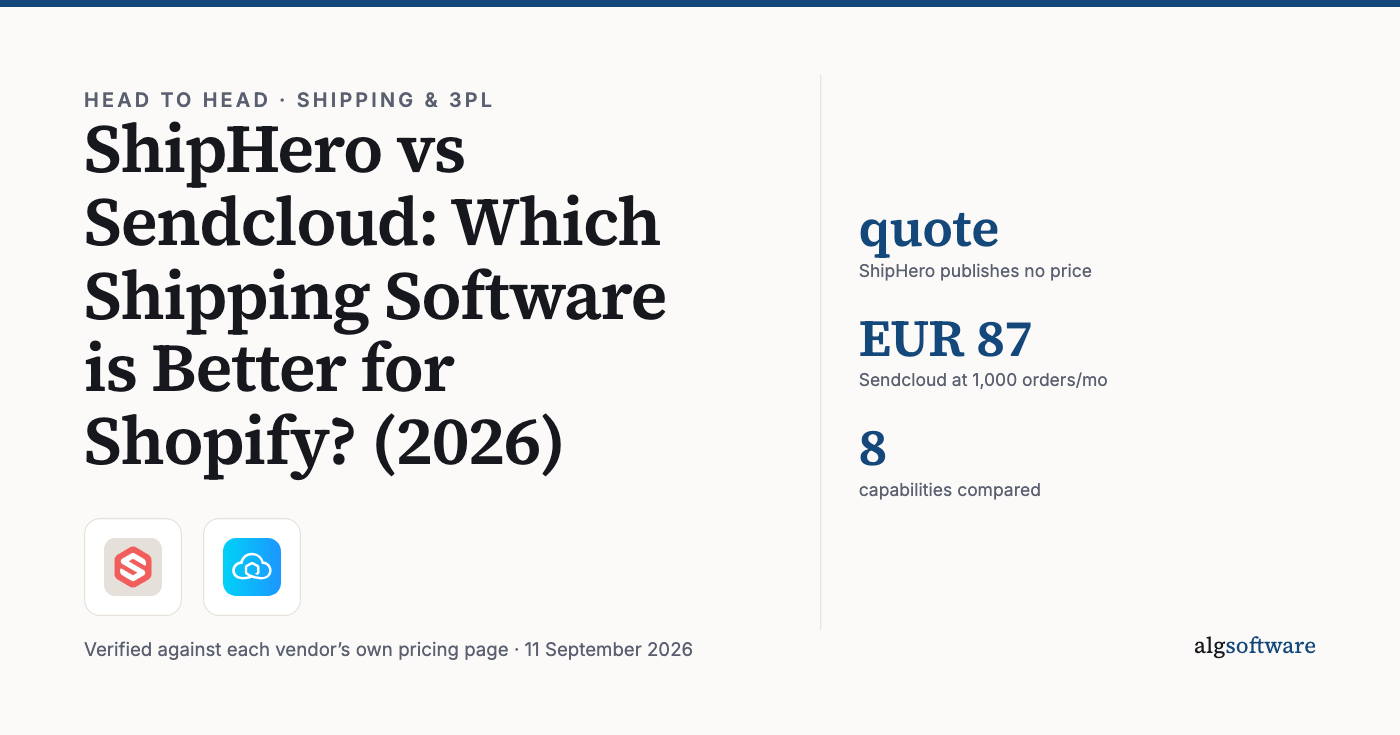
What will this cost you?
| Product | Plan | Published price |
|---|---|---|
| ShipHero | — | Quote-based — contact vendor |
| Sendcloud | Free | EUR 0/mo |
| Sendcloud | Lite | EUR 28/mo + EUR 0.1/order |
| Sendcloud | Growth | EUR 87/mo + EUR 0.09/order |
| Sendcloud | Premium | EUR 175/mo + EUR 0.08/order |
| Sendcloud | Pro | EUR 639/mo + EUR 0.07/order |
| Sendcloud | Enterprise | Contact vendor |
Pricing verified 11 Sept 2026 · source
Pricing verified 11 Sept 2026 · source
ShipHero vs Sendcloud: A Side-by-Side Shipping Software Comparison for Shopify Sellers
If you run a Shopify store and ship physical products, you already know that the gap between a mediocre shipping workflow and a great one is measured in hours per week — and dollars per order. Two platforms that consistently appear on shortlists are ShipHero and Sendcloud, but they approach the problem from very different angles.
In this guide, we’ll walk through everything that matters — warehouse management, carrier options, Shopify integration depth, and pricing — so you can make a confident decision without burning a weekend on a Sendcloud trial and a ShipHero sales call. Only one of the two offers a trial at all: Sendcloud’s runs 14 days with no card required, while ShipHero’s equivalent button books a demo.
 ShipHero Overview
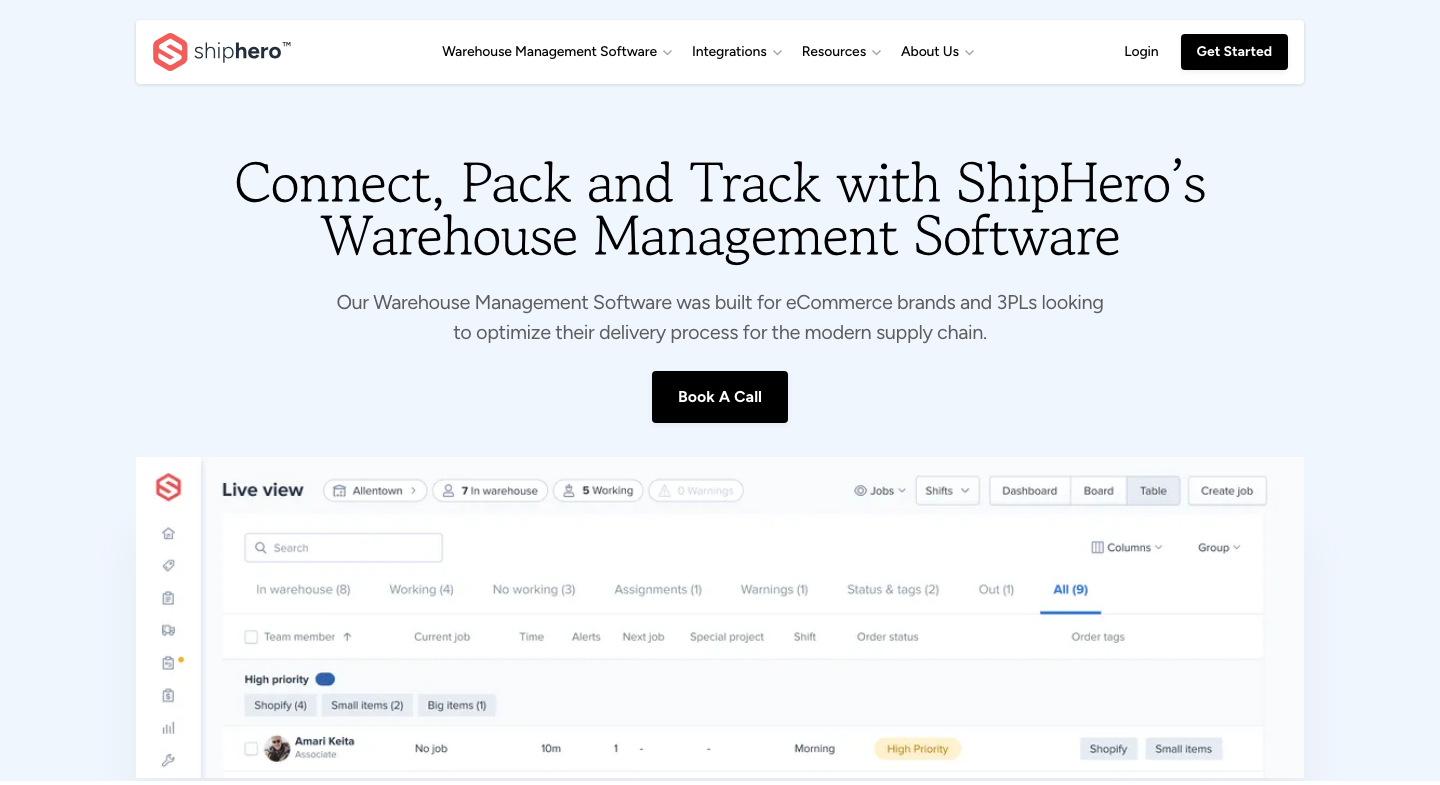
ShipHero started life as an internal tool for a high-volume ecommerce operation and it shows. The platform combines a full warehouse management system (WMS) with multi-carrier shipping, inventory forecasting, and batch fulfillment. It’s designed for brands and 3PLs that process hundreds — or thousands — of orders per day and need granular control over pick, pack, and ship workflows.
Key Features
- Built-in WMS: Barcode scanning, bin/location management, wave picking, and kit/bundle support.
- Multi-warehouse support: Route orders to the optimal warehouse based on proximity, inventory, or custom rules.
- Carrier rate shopping: Automatically compare rates across USPS, UPS, FedEx, DHL, and regional carriers at the point of label creation.
- Inventory forecasting: Demand planning tools that flag low-stock SKUs and suggest reorder quantities.
- Batch processing: Bulk print labels and packing slips for hundreds of orders simultaneously.
- Shopify integration: Native two-way sync for orders, inventory levels, and tracking updates.
- 3PL module: White-label portal for third-party logistics providers managing multiple client accounts.
Pros
- All-in-one WMS + shipping eliminates the need for separate systems
- Excellent for high-volume operations (1,000+ orders/day)
- Strong multi-warehouse and 3PL capabilities
- Robust reporting and analytics dashboard
Cons
- Steeper learning curve — the WMS features add complexity even if you only need shipping
- Pricing is significantly higher than label-only solutions
- Carrier network skews North American; fewer pre-negotiated European carriers
- Smaller merchants may find the feature set overwhelming
 Sendcloud Overview
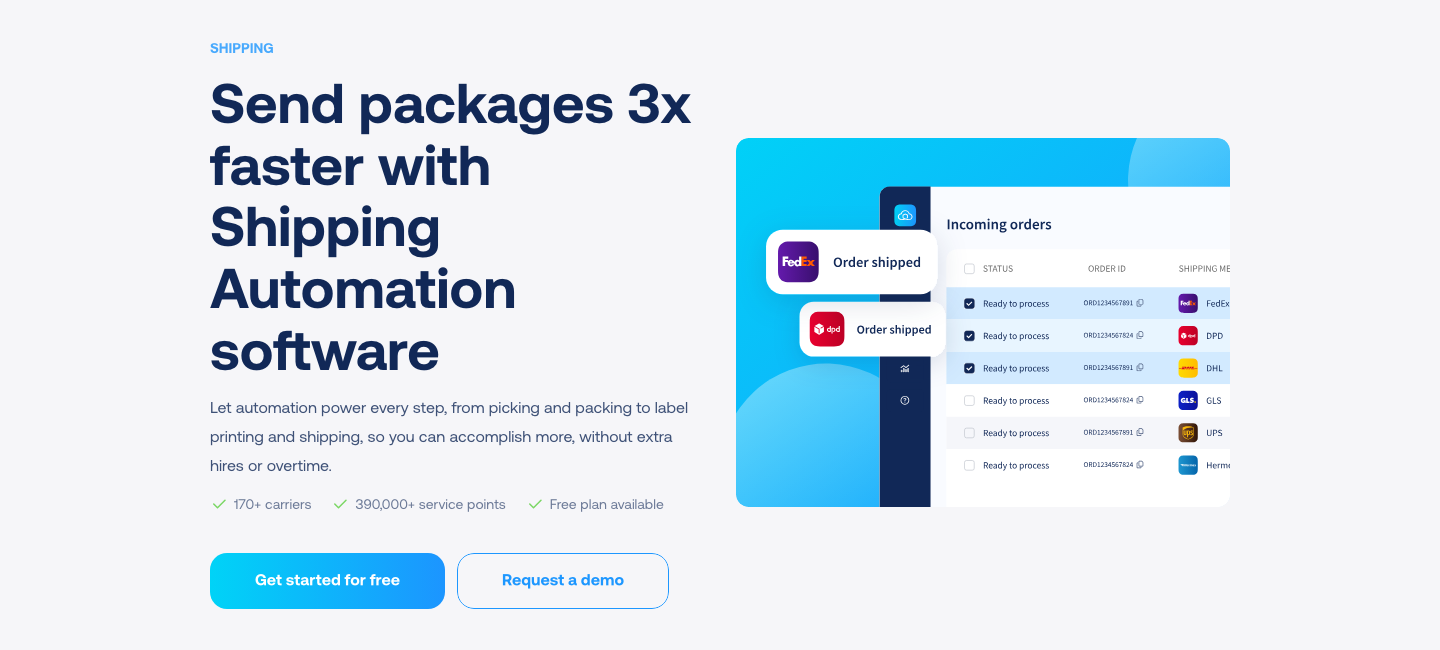
Sendcloud is a shipping automation platform headquartered in the Netherlands that has built its reputation on making multi-carrier label creation dead simple — particularly for European merchants. Rather than trying to be a warehouse management system, Sendcloud focuses on the post-checkout experience: label printing, tracking pages, returns portals, and carrier integrations.
Key Features
- Extensive carrier network: 100+ carrier integrations across Europe, North America, and Australia, including PostNL, DPD, DHL, Colissimo, Royal Mail, UPS, and more.
- Shipping rules engine: Automatically assign carriers, services, and insurance based on weight, destination, order value, or custom tags.
- Branded tracking: Customizable tracking pages and email notifications with your store’s branding.
- Returns portal: Self-service returns page that customers can use to generate return labels without contacting support.
- Checkout optimization: Dynamic delivery options widget for Shopify checkout that shows real-time carrier options and delivery estimates.
- Shopify integration: One-click install via the Shopify App Store with automatic order import and tracking sync.
- Packing slips: Customizable packing slip templates with drag-and-drop editor.
Pros
- Fastest time-to-value — most merchants are printing labels within an hour of setup
- Best-in-class European carrier coverage
- Affordable entry-level pricing with a usable free tier
- Branded tracking and returns portal improve post-purchase CX
- Lightweight; does not force you into a WMS you don’t need
Cons
- No warehouse management — you’ll need a separate WMS if you outgrow spreadsheets
- North American carrier options are growing but not as deep as ShipHero’s
- Advanced shipping rules and analytics locked behind higher-tier plans
- Limited multi-warehouse routing logic
Feature Comparison Table
| Feature | ShipHero | Sendcloud |
|---|---|---|
| Warehouse Management (WMS) | ✅ Full WMS built-in | ❌ Not included |
| Multi-carrier Label Printing | ✅ Yes | ✅ Yes |
| Carrier Network Size | Not published (NA-focused) | 170+ carriers, EU-focused (70+ on the free plan) |
| Shopify Integration | ✅ Native | ✅ Native (App Store) |
| Branded Tracking Pages | ⚠️ Basic | ✅ Fully customizable |
| Returns Portal | ⚠️ Limited | ✅ Self-service portal |
| Shipping Rules Automation | ✅ Advanced | ✅ Advanced (paid plans) |
| Batch Order Processing | ✅ Yes | ✅ Yes |
| Multi-warehouse Routing | ✅ Advanced rules | ⚠️ Basic |
| Inventory Forecasting | ✅ Yes | ❌ No |
| Checkout Delivery Options | ❌ No | ✅ Dynamic widget |
| Free Plan Available | ❌ No | ✅ Yes — up to 20 parcels/month |
Pricing Comparison
Pricing is one of the starkest differences between these two platforms, and it reflects their target markets.
Bottom line on pricing: the two can’t be set against each other as multiples, because only one of them publishes a number. Sendcloud’s ladder is public — €0 on Free, then €28 Lite, €87 Growth, €175 Premium and €639 Pro, each with a per-label fee on top — so you can work out your own bill before you commit. ShipHero publishes nothing: its pricing URLs 404 and the only route to a figure is a quote form. If you only need shipping automation, that asymmetry is the deciding fact, and Sendcloud’s Growth plan covers 1,000 parcels a month at €87 plus €0.09 a label.
Key Takeaway: Don’t pay for warehouse management you won’t use. If your operation runs out of a single location and you’re not doing complex pick-and-pack, Sendcloud’s pricing will deliver far better ROI. But if you’re already outgrowing manual processes and need inventory accuracy, ShipHero’s WMS justifies the premium.
Shopify Integration Depth
Both platforms integrate natively with Shopify, but the integration philosophies differ.
ShipHero + Shopify
ShipHero pulls orders from Shopify and manages them entirely within its own dashboard. Inventory levels sync bidirectionally, so stock counts in Shopify reflect real warehouse quantities. Tracking numbers push back to Shopify automatically. The integration is solid, but because ShipHero is designed to be your operational hub, you’ll spend most of your time in ShipHero’s interface rather than Shopify’s admin.
Sendcloud + Shopify
Sendcloud installs directly from the Shopify App Store and feels more like a native extension of your Shopify admin. Orders import automatically, and Sendcloud’s shipping rules engine processes them without manual intervention. The checkout widget is a standout: it injects real-time delivery options (including estimated delivery dates, pickup points, and service levels) directly into your Shopify checkout, which can improve conversion rates. Tracking and return data sync back seamlessly.
Best For: Matching the Tool to Your Business
Choose ShipHero if:
- You ship 500+ orders per day and need warehouse-level operational control
- You operate multiple warehouses and need intelligent order routing
- You’re a 3PL managing fulfillment for multiple brands
- You need inventory forecasting and demand planning alongside shipping
- Your fulfillment team uses barcode scanners and structured pick/pack workflows
- Your shipping is primarily North American
Choose Sendcloud if:
- You’re a small-to-mid-size Shopify store shipping up to a few thousand parcels per month
- You sell heavily into European markets and need broad EU carrier access
- You want to improve post-purchase experience with branded tracking and self-service returns
- You need a tool that’s fast to set up and doesn’t require warehouse infrastructure
- You want to offer dynamic delivery options at checkout to boost conversion
- Budget is a primary concern and you don’t need WMS functionality
ShipHero Alternatives Worth Considering
If neither ShipHero nor Sendcloud feels like the right fit, here are a few other ShipHero alternatives popular among Shopify merchants:
- ShipStation: A strong middle ground — more shipping features than Sendcloud, less complex than ShipHero. Good NA carrier support and competitive pricing.
- Easyship: Excellent for cross-border shipping with transparent duty and tax calculations at checkout.
- Shippo: Developer-friendly, with a free Starter plan and a single flat paid tier above it. Great for lean operations.
- Pirate Ship: The budget pick — free to use with access to discounted USPS and UPS rates. No frills, but hard to beat on cost for US-based stores.
Our Verdict
Key Takeaway: There is no universal winner here — the right choice depends entirely on your operational complexity, geography, and budget. ShipHero wins on depth; Sendcloud wins on accessibility and speed to value.
For most Shopify stores doing under 5,000 shipments per month, Sendcloud is the smarter starting point. It’s affordable, fast to implement, and its European carrier network is unmatched. The branded tracking pages and returns portal also add tangible value to your customer experience without requiring a separate tool.
For high-volume operations, multi-warehouse brands, and 3PLs, ShipHero is the more capable platform. The WMS alone can replace tools like Logiwa or SKUVault, and having warehouse management and shipping under one roof eliminates data sync issues and reduces your total software stack. The higher price tag is justified when you’re processing enough volume to need that level of control.
Our recommendation: start with the tool that matches your current scale. If you’re early-stage or mid-market, Sendcloud will get you shipping faster and cheaper. If you’ve already hit the pain points that come with scaling — inventory inaccuracies, multi-location complexity, pick/pack inefficiency — ShipHero is built to solve exactly those problems.
Try ShipHero FreeTry Sendcloud Free
At your current volume, who packs your orders?
- We do, in-house — your answer
- A 3PL — your answer
- Both — split by product or region — your answer
- We don't ship physical goods — your answer
One tap, no sign-in. We store the count for each option and nothing else — no cookie, no account, no identifier, and nothing you typed. Nothing is saved on your device, so reloading the page asks again.
See the live Shipping & 3PL leaderboard — every product we have verified in this category, ranked by what it costs at your volume, with every figure dated and sourced.