ShipMonk Review 2026: Pricing, Warehouse Locations and Honest Take
Links on this page are commercial in intent, at no extra cost to you — they never affect which products we recommend. Read the full disclosure.
Choosing a third-party logistics (3PL) partner can make or break your ecommerce operation. ShipMonk has positioned itself as a tech-forward fulfillment provider that promises seamless order processing, transparent pricing, and a growing warehouse footprint. But does it live up to the hype?
This ShipMonk review covers everything you need to know before signing on — from published pricing to warehouse capabilities and the areas where ShipMonk still falls short, based on the company’s own documentation and public information.
What Is ShipMonk?
Founded in 2014 and headquartered in Fort Lauderdale, Florida, ShipMonk is a third-party logistics company that handles warehousing, pick-and-pack fulfillment, inventory management, and shipping for ecommerce businesses. The company has grown rapidly by combining proprietary software with a network of fulfillment centers across the United States and internationally.
ShipMonk serves brands selling through Shopify, Amazon, WooCommerce, BigCommerce, Walmart Marketplace, and dozens of other channels. Their core pitch is simple: let ShipMonk handle logistics so you can focus on growing your brand.
ShipMonk Pricing: What Does It Actually Cost?
One of the most common questions about ShipMonk is around pricing, and the honest answer is that none of it is published. ShipMonk’s pricing page promises to show you “where every dollar goes” and that “every fee [is] explained” — but it explains them inside a proposal, not on the page. To get one you request a quote and pick the monthly order band you sit in: 1–499, 500–1,000, 1,001–5,000, 5,001–50,000 or 50,001+.
What is genuinely useful in advance is the structure of that proposal — the fees it will itemise, and what each one responds to. Those are below. The rates are not, because ShipMonk does not publish them and a plausible-looking range would be worse than no range at all.
Pick and Pack Fees
| Service | Charged | What moves it |
|---|---|---|
| First item pick | Per order | Your monthly order band — the first thing ShipMonk’s quote form asks for |
| Additional item pick | Per extra SKU in the same order | Multi-item orders; single-SKU orders avoid this line entirely |
| Promotional inserts | Per insert | Flyers, coupons and marketing material added at pack time |
| Return processing | Per return | Inspection and restocking labour, so it tracks your return rate |
Storage Fees
Storage is billed monthly by the unit of space your stock occupies, which is why product dimensions matter as much as order volume when you ask for a quote:
| Storage Type | Best For |
|---|---|
| Small bin | Jewelry, cosmetics, small accessories |
| Medium bin | Apparel, supplements, small electronics |
| Large bin | Footwear, bundled products |
| Pallet | Bulk inventory, oversized items |
Key Takeaway: ShipMonk quotes per account, and the first thing its form asks is which monthly order band you are in — so volume, SKU count and product dimensions are what set your rates, and no figure from a webpage (ours included) can stand in for the quote. Ask for the full itemised proposal rather than a headline per-order number; itemisation is the thing ShipMonk actually sells.
Shipping Costs
ShipMonk negotiates discounted carrier rates with major providers including USPS, UPS, FedEx, and DHL. These rates are typically passed along to merchants at a markup, though ShipMonk’s buying power means the rates often beat what small brands can negotiate independently. Shipping costs depend on package weight, dimensions, destination, and selected service level.
ShipMonk’s platform automatically selects the most cost-effective shipping option based on your configured rules, which can save brands meaningful money over time — especially on domestic ground shipments.
Minimum Order Requirements
ShipMonk publishes no minimum order volume. The lowest band on its own quote form is 1–499 orders a month, which is not a promise it will onboard a 20-order-a-month brand — but it does mean the “you need to be doing 500 a month” rule of thumb is not something ShipMonk says anywhere. Ask about eligibility directly, and weigh the answer against whether self-fulfilment is still cheaper for you in the short term.
ShipMonk Warehouse Locations
A 3PL is only as good as its warehouse network. Strategically located fulfillment centers reduce transit times and shipping costs — two things that directly impact customer satisfaction and your bottom line.
As of early 2026, ShipMonk operates fulfillment centers across the following locations:
| Location | Region | Coverage |
|---|---|---|
| Fort Lauderdale, FL | Southeast US | Headquarters; Southeast, Latin America |
| Pittston, PA | Northeast US | Northeast corridor, major metro areas |
| Los Angeles, CA | West Coast US | Pacific states, port proximity |
| Las Vegas, NV | Southwest US | Mountain and Southwest states |
| San Bernardino, CA | Inland Empire | Supplements West Coast capacity |
| Mexico | International | Latin American fulfillment |
| United Kingdom | International | European market access |
ShipMonk’s distributed warehouse model allows brands to split inventory across multiple locations, enabling 2-day ground shipping to roughly 95% of the US population. The platform’s inventory allocation tools help determine optimal stock distribution across warehouses based on your customer demand patterns.
Key Features
Proprietary Software Platform
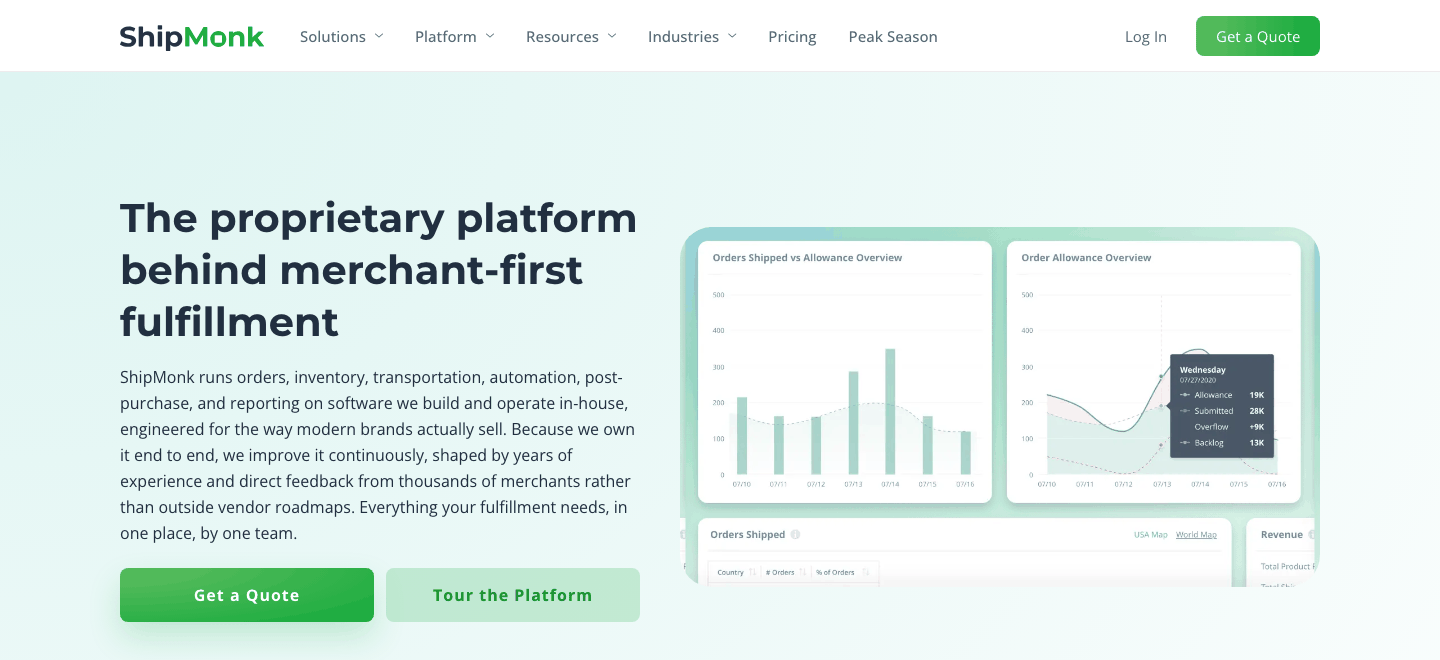
ShipMonk’s biggest differentiator is its proprietary technology platform. Unlike many 3PLs that bolt on third-party warehouse management systems, ShipMonk built its own software from the ground up. The platform provides:
- Real-time inventory tracking across all warehouse locations
- Order management dashboard with filtering, search, and batch actions
- Automated shipping rule engine for carrier selection and service level optimization
- Analytics and reporting including cost-per-order breakdowns, shipping spend, and inventory velocity
- Multi-channel order consolidation pulling from Shopify, Amazon, eBay, Walmart, and 100+ integrations
Integrations
ShipMonk integrates with a wide range of ecommerce platforms, marketplaces, and tools, including:
- Ecommerce platforms: Shopify, Shopify Plus, BigCommerce, WooCommerce, Magento, Squarespace
- Marketplaces: Amazon (FBA and FBM), Walmart, eBay, Etsy, TikTok Shop
- Tools: Klaviyo, Loop Returns, ShipStation, and others (Returnly is on older lists but has been discontinued and folded into Loop Returns)
- Custom: Open API for custom integrations and EDI support
Subscription Box Fulfillment
ShipMonk has carved out a niche in subscription box fulfillment. Their platform supports kitting, assembly, and recurring shipment workflows that are critical for subscription brands. If your business involves monthly boxes or curated product bundles, this is a notable strength worth exploring.
Returns Management
ShipMonk offers return processing with inspection, restocking, and disposition workflows. The platform allows you to set custom return rules and integrates with return management tools like Loop Returns, which is also where Returnly’s technology ended up after Loop acquired and retired it. While not as sophisticated as standalone returns platforms, it covers the basics well for most DTC brands.
Pros and Cons of ShipMonk
Pros
- Strong proprietary technology — the platform is intuitive, data-rich, and gives merchants real visibility into operations
- Multi-warehouse distribution — split inventory to reduce shipping times and costs across the US
- Extensive integrations — native connections to 100+ platforms and marketplaces out of the box
- Subscription box specialization — purpose-built workflows for kitting and recurring shipments
- Discounted carrier rates — access to negotiated rates with USPS, UPS, FedEx, and DHL
- Dedicated account management — higher-volume clients receive hands-on support
- International presence — UK and Mexico facilities enable global fulfillment without separate partners
Cons
- Minimum order thresholds — not ideal for very early-stage brands with low order volumes
- Pricing opacity at lower volumes — while rates are more transparent than before, small brands may find pricing hard to predict until they receive a custom quote
- Onboarding timeline — some users report that initial setup and inventory receiving can take longer than expected
- Customer support variability — while dedicated account managers are a plus, general support ticket response times have drawn mixed reviews
- Oversize and heavy item handling — brands with very large or heavy products may find better pricing with freight-specialized 3PLs
- Contract terms — review contract length and early termination clauses carefully before committing
Who Is ShipMonk Best For?
ShipMonk is a strong fit for the following types of businesses:
- DTC ecommerce brands doing 500–50,000+ orders per month that need reliable, scalable fulfillment
- Subscription box companies that require kitting, assembly, and recurring shipment support
- Multi-channel sellers who need unified inventory management across Shopify, Amazon, Walmart, and beyond
- Brands expanding internationally that want to test UK and Latin American markets without establishing local operations
ShipMonk is not the best fit for micro-businesses doing fewer than 200 orders per month, brands with primarily oversized or heavy freight products, or enterprise operations that need fully customized warehouse workflows with dedicated staffing.
ShipMonk vs. Competitors: A Quick Look
| Feature | ShipMonk | ShipBob | Deliverr (Shopify Logistics) |
|---|---|---|---|
| US Warehouse Locations | 5+ | 30+ | Varies |
| International Warehouses | UK, Mexico | UK, EU, Canada, Australia | Limited |
| Proprietary Software | Yes | Yes | Yes (Shopify integrated) |
| Subscription Box Support | Strong | Moderate | Limited |
| Best For | Mid-size DTC, subscription | Scaling DTC brands | Shopify-native sellers |
User Experience and Onboarding
Getting started with ShipMonk involves an onboarding process that typically includes an initial consultation, warehouse setup, integration configuration, and inventory receiving. The company assigns a dedicated onboarding specialist to guide new clients through the process.
Users generally praise the platform’s dashboard for being clean and easy to navigate. Real-time order tracking, inventory alerts, and cost breakdowns are accessible from the main dashboard. The learning curve is relatively gentle for anyone familiar with ecommerce operations, though first-time 3PL users should expect a brief adjustment period.
That said, some merchants have noted that the inventory receiving process — shipping your products to ShipMonk’s warehouses for the first time — can be slower than expected. Plan for at least 5–10 business days for initial receiving, and communicate with your account manager about any time-sensitive launches.
Our Verdict: Is ShipMonk Worth It in 2026?
Key Takeaway: ShipMonk earns a solid recommendation for mid-size DTC and subscription brands that value technology, transparency, and scalable fulfillment. It is not the cheapest option on the market, but its proprietary software, multi-warehouse distribution, and strong integration ecosystem make it a reliable long-term partner for growing ecommerce businesses.
ShipMonk has matured considerably since its founding. The company’s investment in proprietary technology sets it apart from legacy 3PLs that rely on outdated systems. Its warehouse network, while not the largest, is strategically positioned for fast domestic shipping. And its specialization in subscription box fulfillment fills a genuine gap in the market.
Where ShipMonk needs improvement is in onboarding speed, support consistency for smaller accounts, and pricing clarity for brands just starting out. If you are processing fewer than 500 orders per month, you may want to compare ShipMonk against lighter-weight alternatives or self-fulfillment before committing.
For brands in the 500–50,000+ order range looking for a tech-driven 3PL with room to scale, ShipMonk deserves a spot on your shortlist. Request a custom quote, tour the platform demo, and compare it against at least two other providers before making your decision.
Try ShipMonk FreeThis review is based on publicly available information, user feedback, and editorial research as of early 2026. Pricing and features are subject to change. Always verify current details directly with ShipMonk before making purchasing decisions.
A vendor won't publish its prices. What do you do?
- Skip it — no published price, no shortlist — your answer
- Book the demo anyway — your answer
- Depends how well it fits everything else — your answer
- Ask other merchants what they actually pay — your answer
One tap, no sign-in. We store the count for each option and nothing else — no cookie, no account, no identifier, and nothing you typed. Nothing is saved on your device, so reloading the page asks again.
See the live Shipping & 3PL leaderboard — every product we have verified in this category, ranked by what it costs at your volume, with every figure dated and sourced.