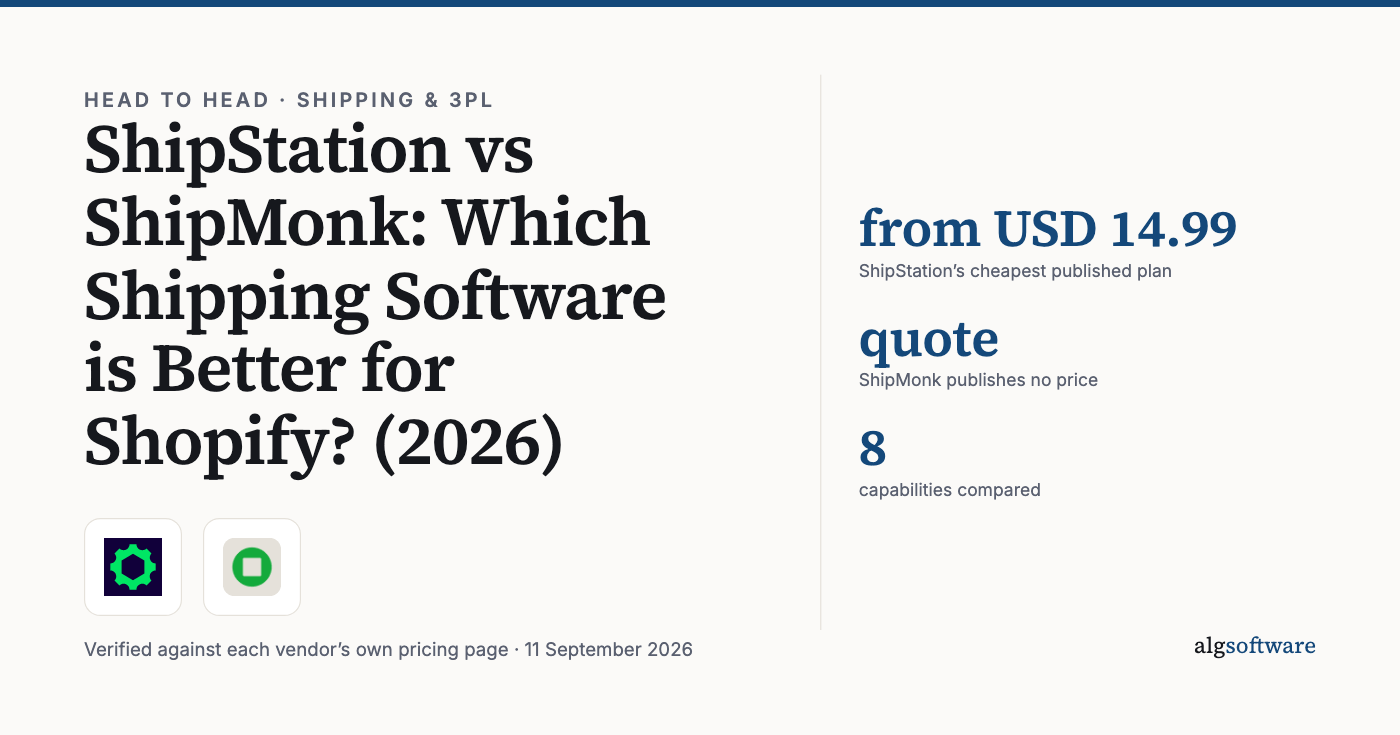
ShipStation vs ShipMonk: Which Shipping Software is Better for Shopify? (2026)
Links on this page are commercial in intent, at no extra cost to you — they never affect which products we recommend. Read the full disclosure.
What will this cost you?
| Product | Plan | Published price |
|---|---|---|
| ShipStation | Starter | USD 14.99/mo |
| ShipStation | Standard | USD 29.99/mo |
| ShipStation | Premium | USD 349.99/mo |
| ShipMonk | — | Quote-based — contact vendor |
Pricing verified 11 Sept 2026 · source
Pricing verified 11 Sept 2026 · source
If you’re running a Shopify store, you already know that getting orders out the door quickly and affordably is just as important as landing the sale in the first place. Two of the most popular platforms that promise to simplify your shipping operations are ShipStation and ShipMonk — but they take very different approaches to the problem.
ShipStation is a cloud-based shipping software designed for merchants who handle their own fulfillment. ShipMonk, on the other hand, is a third-party logistics (3PL) provider that warehouses your inventory and ships orders on your behalf. That fundamental distinction shapes everything from pricing to day-to-day workflow.
In this guide, we’ll compare both platforms across the factors that matter most to Shopify sellers so you can decide which one deserves a spot in your tech stack.
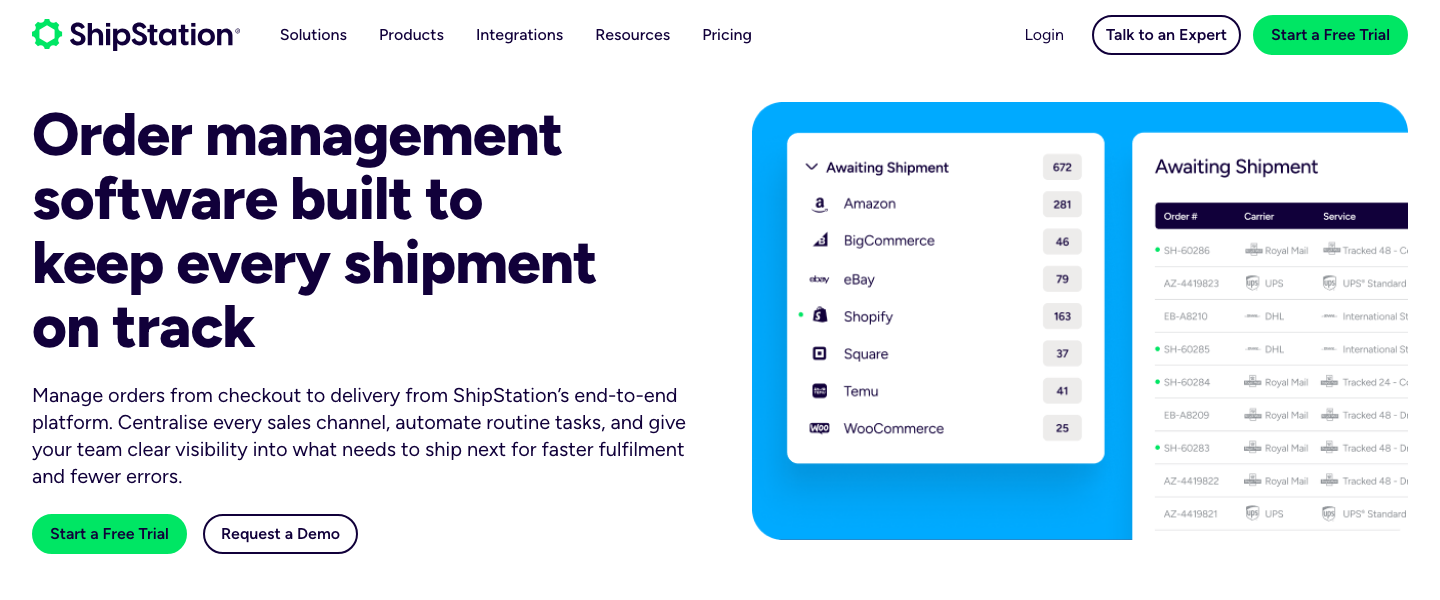
 ShipStation Overview
ShipStation has been a staple in the ecommerce shipping space for over a decade. It connects to more than 180 selling channels, shopping carts, and carriers — including Shopify — and centralizes every order into a single dashboard where you can compare rates, print labels, and automate repetitive tasks.
Key Features
- Multi-carrier rate comparison: Instantly compare rates from USPS, UPS, FedEx, DHL, and dozens of regional carriers to find the cheapest or fastest option.
- Automation rules: Set up if/then rules to automatically assign carriers, apply shipping presets, tag orders, or send branded tracking emails.
- Branded tracking pages: Customize tracking pages with your logo, colors, and marketing assets to keep customers engaged post-purchase.
- Batch label printing: Select hundreds of orders at once and generate labels in seconds.
- Discounted shipping rates: Access pre-negotiated USPS and UPS rates that can save up to 89% off retail pricing.
- Inventory management: Basic stock-level tracking and low-inventory alerts across warehouses.
- Shopify integration: Native, real-time sync that pulls in orders, updates tracking, and manages fulfillment status automatically.
Pros & Cons
| Pros | Cons |
|---|---|
| Extensive carrier and marketplace integrations | No built-in warehousing or fulfillment services |
| Powerful automation engine saves hours per week | UI can feel overwhelming for new users |
| Deeply discounted USPS and UPS rates | Higher-tier plans required for advanced reporting |
| Scales well from small to high-volume sellers | Phone support limited to top-tier plans |
 ShipMonk Overview
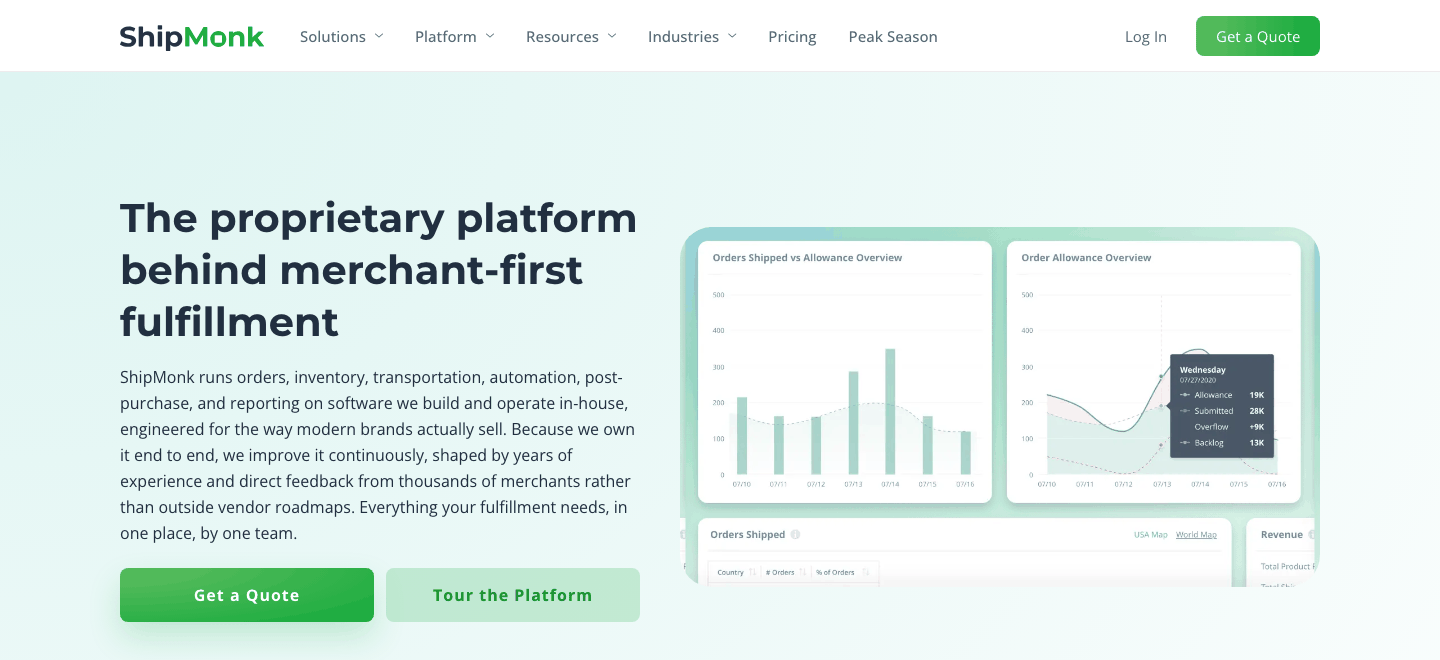
ShipMonk positions itself as an end-to-end fulfillment partner rather than a simple label-printing tool. You send your inventory to one of ShipMonk’s fulfillment centers, and when a Shopify order comes in, their team picks, packs, and ships it for you. It’s a hands-off approach that appeals to brands looking to scale without building out their own warehouse operations.
Key Features
- Full 3PL fulfillment: ShipMonk stores your products, picks and packs orders, and handles shipping — you never touch a box.
- Multiple fulfillment centers: Strategically located warehouses across the US (and internationally) enable faster delivery times and lower shipping zones.
- Real-time inventory visibility: A cloud-based dashboard shows stock levels, inbound shipments, and order status across all locations.
- Subscription box support: Specialized workflows for kitting, assembly, and recurring subscription fulfillment.
- Returns management: ShipMonk processes returns at the warehouse, inspects items, and restocks eligible products.
- Shopify integration: Direct integration that automatically routes Shopify orders to the nearest fulfillment center.
- Custom packaging: Options for branded inserts, custom boxes, and gift wrapping to enhance the unboxing experience.
Pros & Cons
| Pros | Cons |
|---|---|
| Completely hands-off fulfillment | Significantly higher cost than self-fulfillment software |
| Multi-warehouse network for faster delivery | Less control over packing quality and speed |
| Subscription and kitting expertise | Order minimums may not suit very small sellers |
| Returns processing handled for you | Onboarding and inventory transfer can take time |
Head-to-Head Comparison
| Feature | ShipStation | ShipMonk |
|---|---|---|
| Type | Shipping software (self-fulfill) | 3PL fulfillment provider |
| Shopify Integration | Native, real-time sync | Native, real-time sync |
| Carrier Options | 250+ carriers worldwide | Managed by ShipMonk (major carriers) |
| Warehousing | Not included (you use your own) | Included across multiple US locations |
| Pick & Pack | You handle it | ShipMonk handles it |
| Automation | Advanced rules engine | Order routing automation |
| Returns Management | Basic (label generation) | Full warehouse processing |
| Best For | DIY shippers who want control | Brands ready to outsource fulfillment |
Pricing Comparison
Pricing is where these two platforms diverge most dramatically — because you’re paying for fundamentally different services.
ShipStation Pricing
You also pay for postage at discounted rates, but there are no warehousing or pick-and-pack fees since you’re doing that yourself.
ShipMonk Pricing
ShipMonk’s pricing is usage-based and reflects the fact that they’re doing the physical work:
- Pick & pack fees: Per-order fees that decrease as volume increases
- Storage fees: Monthly charges based on bin, shelf, or pallet space used
- Shipping costs: Passed through at ShipMonk’s negotiated carrier rates
- Special projects: Additional charges for kitting, custom inserts, or returns processing
The software is not free, whatever the “pay for what you use” framing suggests: ShipMonk’s own quote page says your custom quote will set out platform, onboarding and any add-on technology fees alongside the physical work. None of those numbers are published — the form asks which monthly order band you sit in (1–499, 500–1,000, 1,001–5,000, 5,001–50,000 or 50,001+) before anyone quotes you. What is safe to say is that the all-in per-order cost lands well above ShipStation’s, because labor and warehousing are inside it.
Key Takeaway: If you have your own warehouse and team, ShipStation is far more affordable. If you factor in the cost of rent, labor, and supplies for self-fulfillment, ShipMonk’s all-in pricing may actually be competitive — especially at scale.
Shopify Integration & Ease of Use
Both ShipStation and ShipMonk offer native Shopify integrations, but the experience differs based on what each platform is designed to do.
ShipStation + Shopify
ShipStation’s Shopify integration is among the most mature on the market. Orders sync in real time, and once you’ve set up your automation rules, the workflow looks like this: orders arrive, rules apply carrier and service presets, you review and batch-print labels, and tracking numbers push back to Shopify automatically. The learning curve is moderate — there are a lot of settings and options — but most sellers get comfortable within a week.
ShipMonk + Shopify
ShipMonk’s integration is simpler from the merchant’s perspective because there’s less for you to do. Once connected, Shopify orders flow into ShipMonk’s system and are automatically routed to the appropriate fulfillment center. You monitor status from a dashboard but don’t need to take action on individual orders. Setup involves sending your inventory to ShipMonk’s warehouse, which adds an onboarding step that can take a few weeks.
Who Should Choose ShipStation?
ShipStation is the better fit if:
- You have your own warehouse, garage, or office space for fulfillment
- You want maximum control over packing, branding, and carrier selection
- Your margins are tight and you need to minimize per-order costs
- You sell on multiple channels (Amazon, eBay, Etsy, Walmart) and want one dashboard
- You enjoy optimizing operations and building shipping automations
- You’re a small-to-mid-size seller processing up to a few thousand orders per month
Who Should Choose ShipMonk?
ShipMonk makes more sense if:
- You don’t have (or don’t want) your own warehouse space
- You’re scaling quickly and fulfillment is becoming a bottleneck
- You sell subscription boxes or products that require kitting and assembly
- You want to offer faster shipping by distributing inventory across multiple locations
- You’d rather invest your time in marketing and product development than packing boxes
- Your order volume is high enough to justify 3PL per-unit economics
ShipStation Alternatives Worth Considering
If neither platform feels like the right fit, here are a few other options popular with Shopify merchants:
- Pirate Ship: Free shipping software with deeply discounted USPS and UPS rates. Great for budget-conscious sellers who want simplicity over features.
- ShipBob: A 3PL competitor to ShipMonk with a strong tech platform and a growing network of fulfillment centers.
- Shopify Shipping: Shopify’s built-in shipping feature offers discounted rates and label printing directly in the admin — no extra software needed.
- EasyShip: Cloud-based shipping platform with a global focus, offering access to 550+ courier services and transparent duty-and-tax calculations.
Our Verdict
Key Takeaway: ShipStation and ShipMonk aren’t really competitors — they serve different stages of the ecommerce growth journey. Choose ShipStation if you fulfill orders yourself and want powerful tools to do it faster. Choose ShipMonk when you’re ready to hand off fulfillment entirely and focus on growing your brand.
For most Shopify sellers who are still in the early-to-mid stages of growth, ShipStation is the more practical starting point. It’s affordable, packed with features, and gives you the control you need to keep quality high and costs low. As your volume grows and self-fulfillment starts to strain your operations, transitioning to a 3PL like ShipMonk becomes a smart strategic move.
The good news? You don’t have to choose one forever. Many successful Shopify brands start with ShipStation, scale their operations, and eventually move to ShipMonk (or a similar 3PL) when the economics make sense. The key is matching your shipping infrastructure to your current stage of growth.
Try ShipStation Free Try ShipMonk FreeAt your current volume, who packs your orders?
- We do, in-house — your answer
- A 3PL — your answer
- Both — split by product or region — your answer
- We don't ship physical goods — your answer
One tap, no sign-in. We store the count for each option and nothing else — no cookie, no account, no identifier, and nothing you typed. Nothing is saved on your device, so reloading the page asks again.
See the live Shipping & 3PL leaderboard — every product we have verified in this category, ranked by what it costs at your volume, with every figure dated and sourced.