Freshdesk vs Kustomer: Which Helpdesk Software is Better for Shopify? (2026)
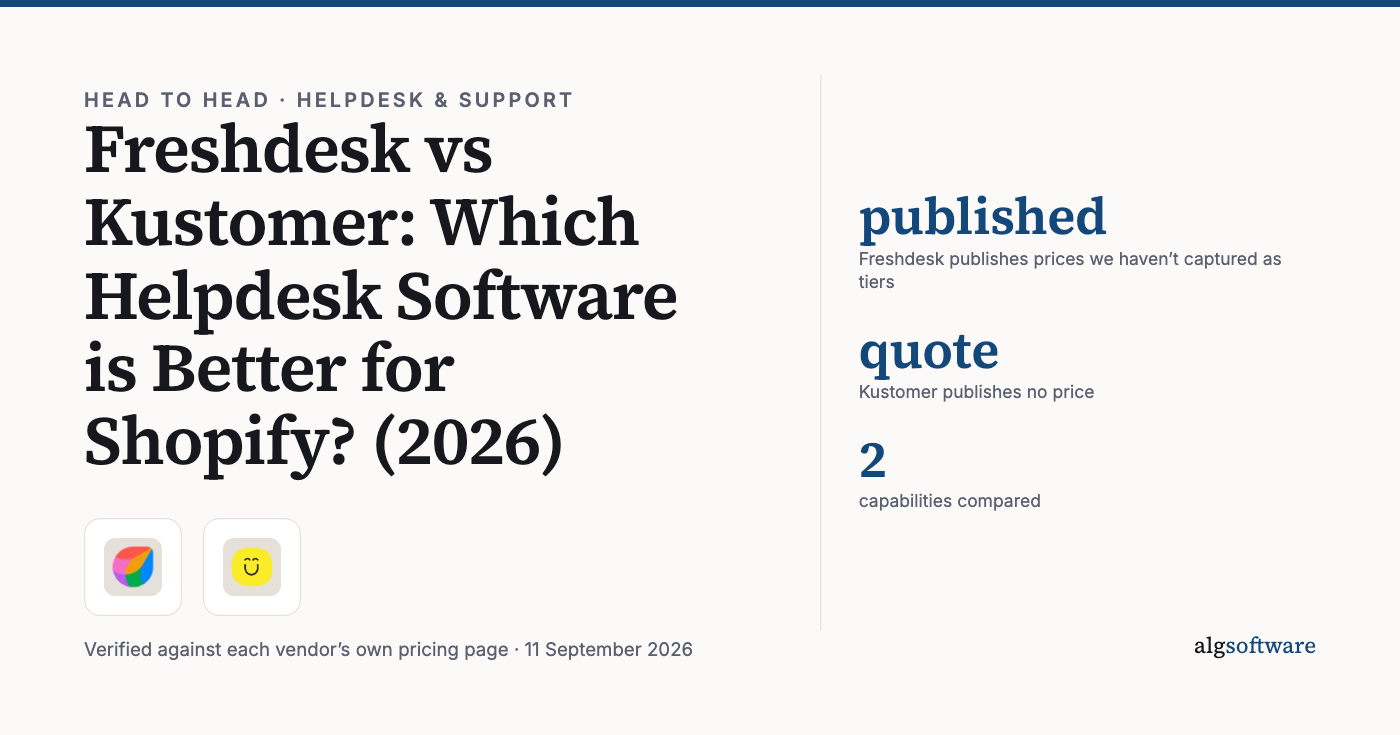
Links on this page are commercial in intent, at no extra cost to you — they never affect which products we recommend. Read the full disclosure.
If you run a Shopify store, you already know that customer support isn’t optional — it’s a revenue driver. The right helpdesk software can reduce response times, boost satisfaction scores, and turn one-time buyers into repeat customers. Two platforms that consistently appear on shortlists are Freshdesk and Kustomer.
But which one is actually the better fit for Shopify merchants? In this guide, we break down both platforms across the dimensions that matter most to ecommerce teams: Shopify integration depth, automation capabilities, pricing, and overall ease of use.
 Freshdesk Overview
Freshdesk, developed by Freshworks, is one of the most widely adopted helpdesk platforms in the world. It serves businesses of every size — from solo entrepreneurs to enterprise support teams — and is known for its intuitive interface, robust ticketing engine, and a free plan that genuinely delivers value.
For Shopify merchants, Freshdesk offers a dedicated Shopify integration available through the Freshworks Marketplace. Once connected, agents can view customer order history, shipping details, and payment information directly within the support ticket — eliminating the need to toggle between tabs.
Freshdesk Key Features
- Omnichannel ticketing: Manage conversations from email, chat, phone, social media, and WhatsApp in a single inbox.
- Freddy AI: Freshworks’ AI engine powers chatbots, auto-triage, suggested responses, and ticket summarization.
- Automations: Time-based and event-based workflow automations let you route, prioritize, and escalate tickets without manual effort.
- Self-service portal: Build a branded knowledge base and community forum to deflect common questions.
- Marketplace integrations: Over 1,000 apps and integrations, including Shopify, Slack, Salesforce, and Jira.
- Collaboration: Shared ownership, linked tickets, and internal notes keep teams aligned.
Freshdesk Pros & Cons
- ✅ Free plan supports up to 2 agents with essential features
- ✅ Clean, easy-to-learn interface — minimal onboarding time
- ✅ Extensive marketplace with pre-built Shopify integration
- ✅ Scalable pricing tiers from startup to enterprise
- ✅ Strong SLA management and reporting
- ❌ Shopify integration shows order data but lacks deep order-action capabilities natively
- ❌ Advanced AI features (Freddy AI) locked behind higher-tier plans
- ❌ Phone support requires Freshcaller add-on, adding to total cost
 Kustomer Overview
Kustomer takes a fundamentally different approach to customer support. Rather than organizing work around tickets, it organizes everything around the customer. Every interaction — email, chat, SMS, social — is displayed on a single, chronological timeline alongside order data, browsing history, and custom events.
Acquired by Meta in 2023 and subsequently operating independently again, Kustomer has carved out a niche among direct-to-consumer (DTC) and ecommerce brands that handle high volumes of customer conversations. Its Shopify integration is one of the deepest on the market, automatically pulling in order data, fulfillment status, and customer lifetime value.
Kustomer Key Features
- Customer timeline: A unified, chronological view of every interaction and data point for each customer — no switching between tickets.
- Native Shopify integration: Automatically ingests orders, refunds, fulfillment updates, and customer profiles. Agents can process refunds and cancellations without leaving Kustomer.
- KIQ AI: AI-powered chatbots, intent detection, and agent-assist features to speed up resolution.
- Business process automation: Flexible workflow engine that can trigger actions based on customer attributes, conversation events, or external data.
- Omnichannel support: Email, live chat, SMS, social media, and voice — all on one platform.
- Custom objects and reporting: Model your data however you need it and build granular reports.
Kustomer Pros & Cons
- ✅ Best-in-class Shopify integration with in-app order actions (refunds, cancellations)
- ✅ Customer-centric timeline eliminates context-switching
- ✅ Purpose-built for high-volume ecommerce and DTC brands
- ✅ Powerful automation engine with flexible triggers
- ✅ Strong sentiment analysis and customer segmentation
- ❌ No free plan and no published price — every route on the pricing page ends in a sales conversation, so you cannot compare it with Freshdesk until you have been quoted
- ❌ Steeper learning curve due to the platform’s depth and customization options
- ❌ Smaller third-party integration marketplace compared to Freshdesk
Freshdesk vs Kustomer: Head-to-Head Comparison
Let’s compare the two platforms across the categories that matter most for Shopify store owners.
| Feature | Freshdesk | Kustomer |
|---|---|---|
| Starting Price | Free (up to 2 agents); paid from $15/agent/mo | Not published — quote only |
| Shopify Integration | View order/customer data in tickets | Deep integration: view, refund, cancel orders in-app |
| AI Features | Freddy AI (chatbot, auto-triage, suggestions) | KIQ AI (chatbot, intent detection, agent-assist) |
| Ticketing Model | Traditional ticket-based | Customer timeline-based (no tickets) |
| Omnichannel | Email, chat, phone, social, WhatsApp | Email, chat, SMS, social, voice |
| Automation | Rule-based workflows, SLA policies | Flexible business process automation |
| Knowledge Base | Built-in, branded portal | Available with integration |
| Marketplace / Integrations | 1,000+ apps | 60+ native integrations |
| Best For | SMBs and growing Shopify stores | High-volume DTC and enterprise ecommerce |
Shopify Integration: A Closer Look
For Shopify merchants, integration depth is arguably the most important differentiator between these two platforms.
Freshdesk + Shopify
Freshdesk’s Shopify app connects your store and surfaces relevant customer and order data within support tickets. When an agent opens a ticket, they can see the customer’s recent orders, shipping status, and contact details in a sidebar widget. This is useful for context, but most order-level actions — like issuing a refund or cancelling an order — still require agents to log into the Shopify admin panel separately.
That said, Freshdesk’s broader marketplace means you can layer on additional Shopify-related apps or use the API to build custom workflows. For stores with moderate ticket volumes, this level of integration is typically sufficient.
Kustomer + Shopify
Kustomer’s Shopify integration goes significantly deeper. Order data, fulfillment events, and customer lifetime value are automatically ingested into the customer timeline. More importantly, agents can take action on orders directly from within Kustomer — processing refunds, initiating cancellations, and updating order details without ever leaving the platform.
For high-volume Shopify stores where agents handle hundreds of order-related inquiries per day, this level of integration can meaningfully reduce average handle time and improve agent productivity.
Key Takeaway: If your team frequently processes refunds, exchanges, or cancellations through your helpdesk, Kustomer’s native Shopify actions give it a clear edge. If your support is more inquiry-based (product questions, shipping updates), Freshdesk’s integration is perfectly adequate.
Pricing Comparison
Pricing is where these two platforms diverge most dramatically, and for many Shopify merchants, it’s the deciding factor — because only one of them will tell you a number.
| Plan | Freshdesk | Kustomer |
|---|---|---|
| Free / Entry | Free (2 agents) | No free plan |
| Growth / Standard | $15/agent/mo | Quote only — no published price |
| Pro / Mid-Tier | $49/agent/mo | Quote only — no published price |
| Enterprise | $79/agent/mo | Custom pricing |
For a five-agent team, Freshdesk’s Pro plan would cost around $245/month. There is no comparable figure for Kustomer, because Kustomer does not publish one: it says plainly that it doesn’t post one-size-fits-all pricing, and its pricing page is a two-minute ROI assessment that ends with a sales conversation rather than a price list. The quote is built from your industry, your agent count and your monthly conversation volume — and Kustomer Voice (talk, SMS and transcription) and WhatsApp are billed pay-as-you-go on top of whatever that quote comes to.
However, if Kustomer’s deeper Shopify integration saves each agent even 30 minutes per day through in-app order actions, the ROI math can start to favor Kustomer for larger teams handling heavy order-related ticket volumes.
Automation & AI Capabilities
Both platforms have invested heavily in AI and automation, but they approach it differently.
Freshdesk’s Freddy AI offers chatbots for self-service deflection, automatic ticket classification and routing, canned response suggestions, and ticket field predictions. These features are practical and well-integrated, though the most powerful AI capabilities require the Pro or Enterprise plans.
Kustomer’s KIQ AI focuses on intent detection, conversational AI bots, and agent-assist tools that suggest next-best actions in real time. Because Kustomer’s data model is customer-centric rather than ticket-centric, its AI can leverage the full customer history — purchase patterns, previous interactions, lifetime value — to deliver more contextually aware suggestions.
For Shopify stores, this distinction matters. Kustomer’s AI can, for instance, detect that a high-value repeat customer is reaching out about a delayed order and automatically prioritize the conversation — something that requires more manual configuration in Freshdesk.
Ease of Use & Onboarding
Freshdesk wins on approachability. Its interface is clean and familiar — if you’ve used any modern SaaS tool, you can navigate Freshdesk within minutes. The onboarding flow is guided, documentation is extensive, and the learning curve is gentle. For small teams without a dedicated support ops person, this matters.
Kustomer is more powerful but more complex. The timeline-based interface takes getting used to, and configuring the platform to its full potential — custom objects, business rules, data integrations — typically requires more upfront investment. Larger teams with a dedicated admin will get the most out of Kustomer’s flexibility.
Who Should Choose Freshdesk?
- Small-to-midsize Shopify stores that need a reliable, affordable helpdesk
- Teams new to helpdesk software that want a gentle learning curve
- Budget-conscious merchants who need a free or low-cost starting point
- Stores with diverse support needs that benefit from a large app marketplace
- Businesses that primarily handle inquiry-based support (product questions, shipping status, pre-sale queries)
Who Should Choose Kustomer?
- High-volume Shopify and Shopify Plus stores processing hundreds of tickets per day
- DTC brands where customer experience is a core differentiator
- Teams that need in-app order actions (refunds, cancellations, exchanges) to maximize agent efficiency
- Stores that want a customer-centric view rather than a ticket-centric one
- Enterprise ecommerce operations with the budget and admin resources to leverage advanced customization
Freshdesk Alternatives Worth Considering
If neither Freshdesk nor Kustomer feels like the perfect fit, here are a few other Freshdesk alternatives popular with Shopify merchants:
- Gorgias: Purpose-built for ecommerce with deep Shopify integration and revenue-tracking features. A strong middle ground between Freshdesk and Kustomer.
- Zendesk: The industry standard for enterprise support. More expensive than Freshdesk, but unmatched in scalability and customization.
- Help Scout: A simpler, email-first helpdesk with a clean interface. Great for small teams that value simplicity.
- Tidio: Affordable live chat and chatbot solution that integrates well with Shopify for stores focused on real-time support.
The Verdict: Freshdesk vs Kustomer for Shopify
Key Takeaway: There is no universally “better” platform — the right choice depends on your store’s size, ticket volume, budget, and how deeply you need your helpdesk to integrate with Shopify’s order management.
Choose Freshdesk if you want an affordable, easy-to-adopt helpdesk that covers all the basics and scales with your business. Its free plan alone makes it the best helpdesk for Shopify merchants who are just getting started with structured customer support.
Choose Kustomer if you’re a high-volume ecommerce brand that needs agents to live inside a single platform — viewing customer histories, processing refunds, and managing orders without context-switching. You will have to ask what that costs — Kustomer quotes rather than publishes — and the answer is worth getting when support efficiency directly impacts your bottom line.
Whichever platform you choose, the most important thing is to actually connect it to your Shopify store and set up automations early. A helpdesk is only as good as the workflows behind it.
Try Freshdesk Free Try Kustomer FreeA vendor won't publish its prices. What do you do?
- Skip it — no published price, no shortlist — your answer
- Book the demo anyway — your answer
- Depends how well it fits everything else — your answer
- Ask other merchants what they actually pay — your answer
One tap, no sign-in. We store the count for each option and nothing else — no cookie, no account, no identifier, and nothing you typed. Nothing is saved on your device, so reloading the page asks again.
See the live Helpdesk & Support leaderboard — every product we have verified in this category, ranked by what it costs at your volume, with every figure dated and sourced.