Intercom vs Kustomer: Which Helpdesk Software is Better for Shopify? (2026)
Links on this page are commercial in intent, at no extra cost to you — they never affect which products we recommend. Read the full disclosure.
Intercom vs Kustomer: Finding the Right Helpdesk for Your Shopify Store
If you run a Shopify store, you already know that customer support isn’t optional — it’s a competitive advantage. The helpdesk software you choose directly impacts response times, customer satisfaction, and ultimately, revenue. Two platforms that consistently appear in the conversation are Intercom and Kustomer.
Both are capable, modern platforms, but they take fundamentally different approaches to customer service. Intercom has evolved from a messaging-first tool into a full-blown AI-powered support platform, while Kustomer (now part of the Meta family) built its reputation on a CRM-centric model that treats every interaction as part of a unified customer timeline.
So which one is actually better for Shopify merchants? We dug into the features, integrations, and pricing of both platforms to help you make the right call.
 Intercom Overview
Intercom has become one of the most recognized names in customer communication software. Originally launched as a live chat and messaging tool, it has significantly expanded its feature set over the years to include a powerful AI assistant (Fin), a shared inbox, help center capabilities, outbound messaging, and robust automation workflows.
For Shopify merchants, Intercom offers a native integration that pulls in order data, customer profiles, and event tracking directly into the agent workspace. This means your support team can see a customer’s recent purchases, shipping status, and browsing behavior without switching tabs.
Key Features for Shopify Stores
- Fin AI Agent: Intercom’s AI assistant can resolve common Shopify queries — order status, return policies, product questions — automatically, reducing ticket volume significantly.
- Native Shopify Integration: Pulls in customer data, order history, and real-time events directly into conversations.
- Proactive Messaging: Trigger in-app messages and banners based on customer behavior, cart value, or page visits.
- Custom Bots & Workflows: Build no-code automation flows to route, tag, and resolve tickets without human intervention.
- Help Center: Built-in knowledge base that feeds into the AI agent for self-service support.
- Omnichannel Inbox: Manage conversations from chat, email, social media, and SMS in a single workspace.
Intercom Pros & Cons
| Pros | Cons |
|---|---|
| Industry-leading AI resolution capabilities with Fin | Pricing can escalate quickly at higher volumes |
| Excellent Shopify integration with real-time data sync | Per-resolution AI pricing adds unpredictability |
| Modern, intuitive interface that agents love | Advanced features locked behind higher-tier plans |
| Strong proactive messaging and product tour tools | Reporting could be more customizable on lower tiers |
| Extensive app marketplace and API | Can feel feature-heavy for very small teams |
 Kustomer Overview
Kustomer takes a different philosophical approach to helpdesk software. Rather than organizing support around tickets or conversations, Kustomer organizes everything around the customer. Every interaction — whether it’s an email, chat, phone call, or social media message — appears on a single, chronological timeline for each customer.
Acquired by Meta in 2023, Kustomer has continued to develop its platform with a focus on omnichannel support, intelligent routing, and CRM-like customer profiles. For Shopify sellers handling high volumes of repeat customers, this customer-centric model can be a significant advantage.
Key Features for Shopify Stores
- Unified Customer Timeline: Every touchpoint — orders, returns, chats, emails, calls — displayed in a single chronological view per customer.
- Shopify Integration: Syncs order data, customer details, and fulfillment information into the customer timeline.
- KustomerIQ (AI): AI-powered features including intent detection, suggested responses, and automated classification.
- Omnichannel Support: Native support for email, chat, SMS, social media, WhatsApp, and voice — all within the same interface.
- Business Process Automation: Visual workflow builder for automating routing, tagging, SLA management, and follow-ups.
- Custom Objects & Data Modeling: Flexible data architecture lets you model Shopify-specific entities like subscriptions or loyalty tiers.
Kustomer Pros & Cons
| Pros | Cons |
|---|---|
| Unified customer timeline is exceptional for context | Higher starting price than many competitors |
| True omnichannel including native voice support | AI capabilities not as advanced as Intercom’s Fin |
| Flexible data model suits complex ecommerce setups | Steeper learning curve for initial setup |
| Strong routing and SLA management tools | Smaller third-party integration marketplace |
| Per-agent pricing is more predictable | UI feels more utilitarian compared to Intercom |
Head-to-Head Feature Comparison
Let’s break down how these two platforms stack up across the categories that matter most to Shopify merchants.
| Feature | Intercom | Kustomer |
|---|---|---|
| Shopify Integration | Native — orders, customers, events | Native — orders, customers, fulfillment |
| AI Automation | Fin AI Agent — advanced, autonomous | KustomerIQ — intent detection, suggestions |
| Live Chat | Excellent — highly customizable messenger | Good — functional chat widget |
| Email Support | Full support with shared inbox | Full support within customer timeline |
| Voice/Phone | Via integrations (e.g., Aircall) | Native voice channel included |
| Social & WhatsApp | Supported | Supported (strong WhatsApp via Meta) |
| Knowledge Base | Built-in, feeds AI agent | Built-in knowledge base |
| Reporting | Good — custom reports on higher plans | Strong — custom dashboards and reports |
| Proactive Messaging | Excellent — banners, tours, targeted messages | Limited proactive outreach tools |
| Pricing Model | Per seat + per AI resolution | Per agent/month |
Shopify Integration Depth
Both platforms integrate with Shopify, but the experience differs in meaningful ways.
Intercom’s Shopify integration is polished and well-maintained. Once connected, your agents see customer profiles enriched with Shopify data — recent orders, lifetime spend, cart contents, and custom attributes. The real power comes when you combine this data with Intercom’s automation: you can trigger messages based on order events, route VIP customers to senior agents, or let Fin handle “where is my order” queries autonomously by pulling real-time tracking data.
Kustomer’s Shopify integration takes a slightly different approach. Rather than just surfacing Shopify data in a sidebar, Kustomer ingests it into the customer timeline as native objects. This means an agent sees a customer’s chat from last week, their order from yesterday, a shipping update from this morning, and today’s email — all in one scrollable timeline. For stores with complex order histories or subscription models, this holistic view can be incredibly valuable.
Key Takeaway: Intercom gives you more tools to act on Shopify data through automation and AI. Kustomer gives you a better way to see and understand the full customer journey across Shopify and other channels.
AI and Automation Compared
This is where the gap between the two platforms is most noticeable in 2026.
Intercom’s Fin AI Agent has become one of the most capable AI support agents on the market. It can hold natural conversations, pull information from your help center and Shopify data, perform actions like initiating refunds or updating orders (with proper configuration), and escalate gracefully to human agents when needed. For Shopify stores dealing with high volumes of repetitive queries, Fin can resolve a significant percentage of tickets without human involvement.
Kustomer’s KustomerIQ offers AI-powered features including intent detection, automated routing, and suggested responses for agents. While functional, it operates more as an agent-assist tool than a fully autonomous resolution engine. It helps your team work faster rather than replacing front-line interactions entirely.
If reducing ticket volume through AI automation is a primary goal, Intercom has a clear advantage here.
Pricing Considerations for Shopify Merchants
Pricing is always a critical factor, especially for growing Shopify businesses watching their margins.
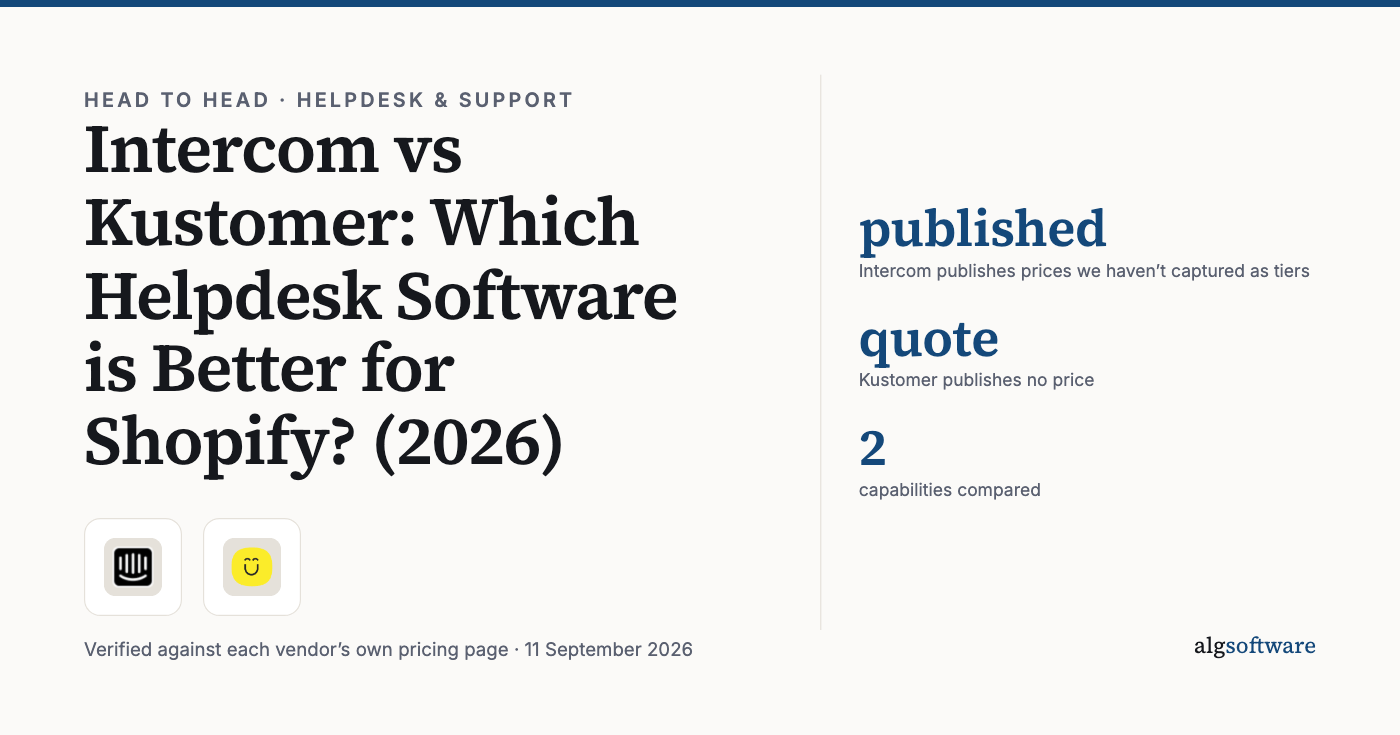
Intercom uses a per-seat pricing model with plans starting at roughly $39/seat/month for the Essential tier (with higher tiers unlocking more features). On top of seat costs, Fin AI resolutions are billed separately — typically around $0.99 per resolution. This means your AI costs scale with usage, which is great when volumes are low but can add up quickly during peak seasons like Black Friday.
Kustomer publishes no prices at all — it says plainly that it doesn’t post one-size-fits-all pricing, and its pricing page is a two-minute ROI assessment that ends with a sales conversation. The quote is built from your industry, your agent count and your monthly conversation volume, so headcount is an input rather than the whole formula. One thing the pricing page is explicit about: it is not entirely all-inclusive. Kustomer Voice — talk, SMS and transcription — and WhatsApp are billed pay as you go on top of the subscription.
For small Shopify stores with 1–3 agents, Intercom’s published entry point is the attraction: you can price it yourself, today. Kustomer asks you to book a conversation before you can compare anything at all, which is a real cost when you are choosing between two platforms — but it also means the deal is scoped to your channel mix and volume rather than to a seat count, which is what mid-market brands with heavy AI usage on Intercom should be asking about.
Best Fit Scenarios
Choose Intercom if:
- You want best-in-class AI to resolve tickets automatically
- Proactive messaging (cart abandonment, onboarding, announcements) is important to your strategy
- You’re a small to mid-sized Shopify store looking for a modern, easy-to-adopt platform
- Your team values a sleek UI and fast onboarding
- Chat and in-app messaging are your primary support channels
Choose Kustomer if:
- You handle high-touch, complex support interactions across multiple channels
- A unified customer timeline is more important than flashy AI features
- You need native voice support without third-party integrations
- Predictable per-agent pricing is critical for your budget planning
- You run a larger operation with custom data models (subscriptions, loyalty programs, wholesale tiers)
Our Verdict: Intercom vs Kustomer for Shopify in 2026
Both platforms are strong, but they serve different types of Shopify businesses.
For most Shopify merchants, especially those in the small-to-mid-market range, Intercom is the better overall choice. Its AI capabilities are a genuine differentiator — being able to automatically resolve a large chunk of repetitive queries (order tracking, return policies, product questions) translates directly into cost savings and faster response times. The Shopify integration is tight, the interface is best-in-class, and the proactive messaging tools can drive revenue in addition to supporting customers.
Kustomer earns its place for larger Shopify brands that operate across many channels and need a truly unified view of every customer interaction. If your support team handles complex, multi-touch cases — think high-value orders, B2B wholesale, or subscription management — Kustomer’s timeline-first approach and flexible data modeling give agents the context they need without hunting through multiple systems.
Key Takeaway: For the majority of Shopify stores looking to modernize their support in 2026, Intercom delivers the best combination of AI automation, ease of use, and Shopify integration. Choose Kustomer if you need deeper CRM-style customer context and true omnichannel coverage at scale.
Try Intercom Free Try Kustomer FreeFrequently Asked Questions
Can I use Intercom and Kustomer together with Shopify?
Technically yes, but it’s not recommended. Running two helpdesk platforms simultaneously creates confusion for agents and fragments your customer data. Pick one and commit to it.
Which platform is easier to set up with Shopify?
Intercom generally has a faster setup process with its Shopify app. You can be up and running with basic chat support within an hour. Kustomer’s setup takes longer due to its more complex data modeling, but the payoff is a more customized environment.
Are there Intercom alternatives specifically built for Shopify?
Yes. If neither Intercom nor Kustomer fits your needs, consider Gorgias (built specifically for ecommerce), Zendesk (broad feature set with Shopify integration), or Help Scout (simpler, more affordable option for small teams). Each has its own strengths depending on your store’s size and complexity.
Does Kustomer still operate independently after the Meta acquisition?
Kustomer continues to operate as its own platform. The Meta acquisition has strengthened its WhatsApp and social messaging integrations, which can be a plus for Shopify stores with international customer bases.
A vendor won't publish its prices. What do you do?
- Skip it — no published price, no shortlist — your answer
- Book the demo anyway — your answer
- Depends how well it fits everything else — your answer
- Ask other merchants what they actually pay — your answer
One tap, no sign-in. We store the count for each option and nothing else — no cookie, no account, no identifier, and nothing you typed. Nothing is saved on your device, so reloading the page asks again.
See the live Helpdesk & Support leaderboard — every product we have verified in this category, ranked by what it costs at your volume, with every figure dated and sourced.